By Yevhen Kovalchuk · Updated November 7, 2026 · 7 min read
Short answer
N is the capacity needed to carry the load, N+1 adds one spare unit so the plant survives the loss of any single machine, and 2N duplicates the whole system. Concurrent maintainability means any component can be taken out for maintenance without shutting down cooling. Choose the level from the cost of downtime, not from habit.
In a cooling plant, N is the number of chillers, pumps or towers needed to carry the full design load. N+1 adds one more unit, so the plant still meets the load if any single unit fails or is out for maintenance. 2N provides two complete, independent systems, each able to carry the load alone. The right level depends on what an hour without cooling costs, how long repairs take, and how much the owner will pay for spare capacity that mostly sits idle.
What do N, N+1 and 2N mean?
| Level | What it means | Survives |
|---|---|---|
| N | Exactly the capacity needed, no spare | Nothing: any failure reduces capacity |
| N+1 | N units plus one spare, usually with shared piping | One unit failing or in maintenance |
| N+2 | N units plus two spares | Two units out at once |
| 2N | Two full systems, separate equipment and distribution | Loss of an entire system |
| 2N+1 | Two full systems, each with an extra unit | An entire system plus one more unit |
A simple example: a load needs 600 tons. With three 300-ton chillers, N is two machines and N+1 is the third. With four 200-ton machines, N is three and N+1 is the fourth. Splitting the load across more, smaller machines makes the spare cheaper in proportion, and usually improves part-load behavior too. See chiller sizing basics.
The letter applies to each layer separately. A plant can be N+1 on chillers but N on pumps or on a single header. Redundancy is only as good as its weakest shared component.
Why is N+1 so common?
N+1 gives the largest reduction in risk for a moderate cost. Chillers fail or need maintenance one at a time far more often than two at once, so a single spare covers the typical event. It fits well with the way chiller plants are already built, with multiple machines on a common header and staged operation.
It does not cover everything:
- A fault in shared piping, a header valve, or the controls platform can take out the whole plant.
- Loss of power or water affects every machine at once.
- A second failure while the first is being repaired exceeds the design.
Those gaps are why higher-criticality facilities look beyond N+1.
What is concurrent maintainability?
Concurrent maintainability means every planned maintenance activity can be done on any component or path without interrupting the load. It is a design property rather than a count of machines. To achieve it, a plant needs isolation valves, bypass piping and independent electrical feeds so that a chiller, pump, valve section or power path can be removed from service while the rest carries the full load.
N+1 machines alone do not guarantee it. If three chillers share one header with no sectionalizing valves, a header repair still takes the plant down. Many designs pair N+1 equipment with looped or dual-path piping to close that gap.
Related, fault tolerance means the plant tolerates an unplanned failure of any single component without losing the load. Concurrent maintainability concerns planned work, and fault tolerance concerns surprise failures. Higher data center classifications generally ask for both, and the organizations that define them publish the exact criteria. Check the current definition rather than relying on summaries.
How does it apply to data centers?
Data halls produce heat continuously, and temperature can climb quickly when cooling stops. That makes redundancy part of the core design.
- Chillers and towers are commonly N+1 or better, often arranged so one tower cell, chiller and pump can be removed without lowering capacity.
- Distribution may be dual loops or a ring header so a pipe section can be isolated.
- Power for cooling matters as much as the chillers. Chilled water pumps and controls usually need backed-up power to ride through a utility outage.
- Thermal storage can bridge the time between loss of chillers and their restart. See thermal energy storage explained.
- Controls should fail safe and avoid a single point of failure.
Texas adds its own concerns: summer design temperatures, grid events and water supply for towers. See data center chillers and cooling towers in Texas, texas heat and chiller capacity and ERCOT large load and cooling design. For the cooling options in the hall itself, see data center cooling explained.
How does it apply to hospitals?
Hospitals need continuous cooling for operating rooms, imaging, labs, pharmacy, sterile processing and patient areas. Requirements come from health care facility codes and standards, such as those used by authorities having jurisdiction, and from the hospital’s own risk assessment. Specifics vary, so confirm current requirements with the engineer of record and the authority having jurisdiction.
Typical design themes include:
- N+1 chillers on essential loads, sometimes with a second plant or a tie-in to a campus loop.
- Critical areas on emergency power with defined restart behavior.
- Isolation valves that let sections be serviced without shutting down whole wings.
- A plan for temporary cooling connections, for example a pre-installed connection point for a rental chiller.
Hospitals differ from data centers in that comfort and humidity control, pressure relationships and infection control all matter alongside temperature.
How do you choose the right level?
- Estimate the cost of downtime. Include lost production, spoiled product, data loss, patient impact and recovery time. Be specific and use real numbers from the business.
- Identify the single points of failure. Walk the plant: chillers, pumps, towers, headers, valves, power feeds, controls and water supply.
- Consider repair time. A failure that takes days to repair needs more redundancy than one fixed in hours. Lead time for large chillers or compressors can run to weeks or months.
- Decide on the maintenance approach. If maintenance cannot be scheduled with the load offline, concurrent maintainability is needed.
- Compare options. Four smaller machines at N+1, a second plant, rental connection points or storage may each meet the need at different cost.
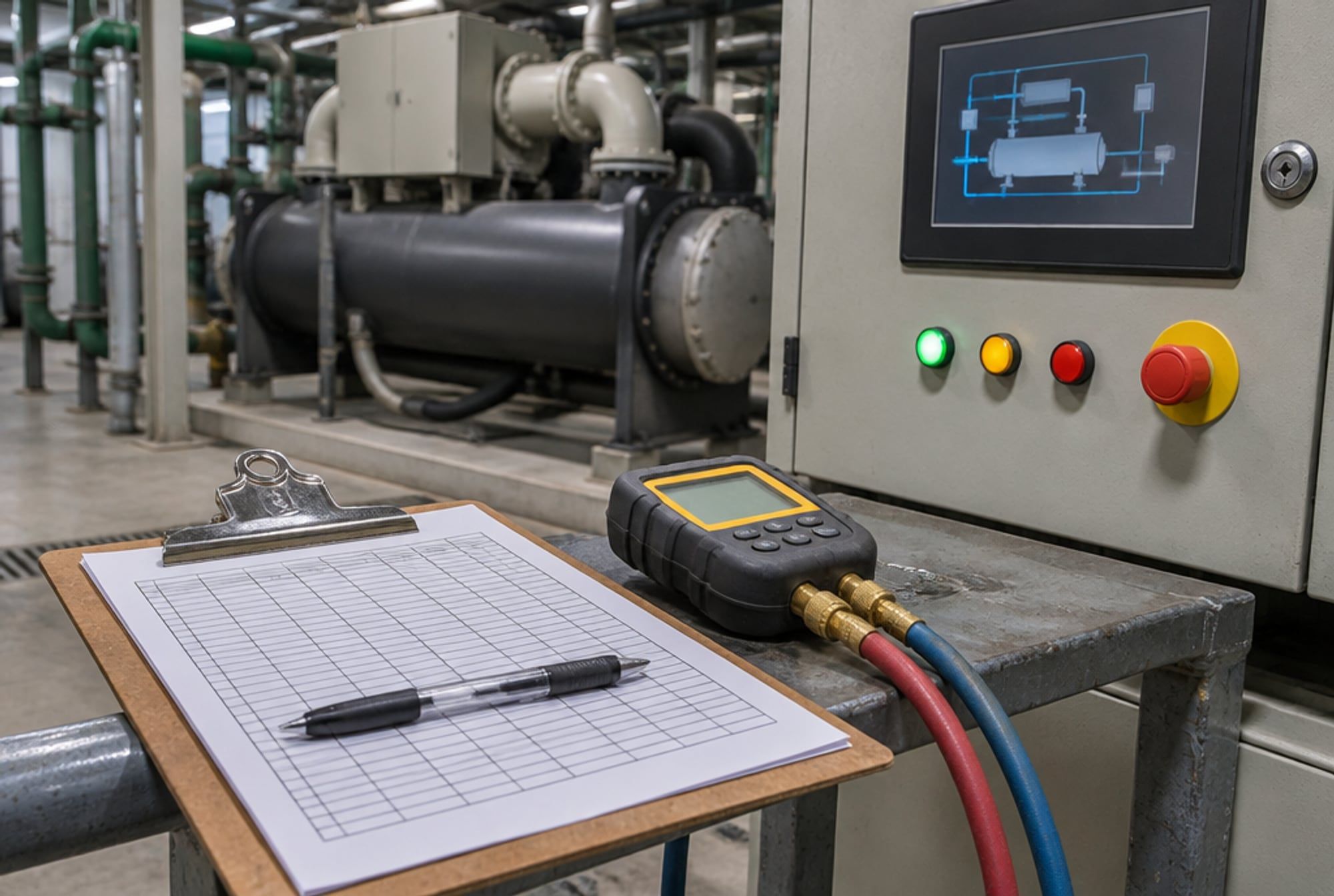
- Plan operations. Redundant equipment must be exercised. Rotate lead and lag, test failover and keep spare parts and procedures ready. Keep a clean record of readings; see chiller log sheet: what to record.
Redundancy also has a cost beyond the equipment: more floor space, more piping, more power infrastructure and a more complex control sequence. Part-load efficiency can improve with more machines, but efficiency depends on the control strategy; see chiller plant control basics.
Frequently asked questions
Is N+1 enough for a data center?
It can be, depending on the reliability target and the design of the rest of the plant. Many facilities use N+1 for chillers but add dual power paths, isolation valves and storage to approach concurrent maintainability. For the highest classifications, 2N or similar approaches are common. The design should come from a documented risk analysis.
Does N+1 mean the spare chiller is always off?
Not necessarily. In many plants all machines run at partial load, which can be more efficient, and the plant still has the capacity to carry the load if one stops. Others run N units and keep one on standby. Controls decide which approach is used, and both can meet N+1 as long as the load can be carried after losing any single unit.
What is the difference between redundancy and resilience?
Redundancy is spare equipment. Resilience is the plant’s ability to keep the load through failures, which also depends on design, controls, power, water, maintenance and people. A plant with spare machines can still fail if a shared component fails or operators are not trained for failover.
SpecServis engineers in Ukraine work with industrial chillers and refrigeration plants. We are planning to enter the Central Texas market and are looking for technicians, partners and a company to buy. See our open positions or partnership options.