By Tamika Brooks · Updated August 14, 2026 · 8 min read
Short answer
Chiller efficiency is expressed as kW per ton (lower is better), COP or EER (higher is better). They convert directly: kW/ton = 12 / EER = 3.516 / COP. Full-load figures are rated at standard conditions, while IPLV and NPLV weight performance at 100, 75, 50 and 25 percent load under AHRI Standard 550/590. Compare ratings only at the same conditions and with the same scope of included equipment.
Chiller efficiency is the amount of electrical power a machine needs to deliver a ton of cooling. In the U.S. it is most often quoted as kW per ton, where a lower number is better. The same performance can also be stated as COP (coefficient of performance) or EER (energy efficiency ratio), where higher is better. Because chillers run at part load most of the time, full-load numbers alone are misleading, which is why the industry also uses IPLV and NPLV, weighted part-load values defined in AHRI Standard 550/590.
What does kW per ton mean?
One ton of refrigeration is 12,000 BTU per hour. kW per ton is the input electrical power in kilowatts divided by the cooling output in tons.
- A chiller producing 500 tons while drawing 300 kW has an efficiency of 0.6 kW/ton.
- Lower kW/ton means less electricity per unit of cooling.
Because it is a ratio of input to output, it is easy to turn into an annual energy estimate: tons of load multiplied by hours multiplied by kW per ton. That estimate must use part-load efficiency, as explained below.
How do kW/ton, COP and EER convert?
All three describe the same thing in different units:
- COP = cooling output / electrical input, both in the same units. It has no units.
- EER = cooling output in BTU/hr / electrical input in watts.
- kW/ton = electrical input in kW / cooling output in tons.
Conversions:
- kW/ton = 12 / EER
- kW/ton = 3.516 / COP
- EER = 3.412 x COP
| kW/ton | COP | EER |
|---|---|---|
| 0.50 | 7.03 | 24.0 |
| 0.60 | 5.86 | 20.0 |
| 0.70 | 5.02 | 17.1 |
| 0.90 | 3.91 | 13.3 |
| 1.00 | 3.52 | 12.0 |
| 1.20 | 2.93 | 10.0 |
Water-cooled centrifugal and screw machines are commonly rated at around 0.5 to 0.7 kW/ton at full load, and air-cooled machines at roughly 0.9 to 1.3, but the spread within each type is wide and depends on model, conditions and refrigerant.
What are the standard rating conditions?
AHRI Standard 550/590 (I-P units) sets the conditions at which water-chilling packages are tested and rated, so different manufacturers can be compared. Typical full-load conditions include:
- Evaporator: 44°F leaving chilled water, with a 10°F temperature drop (54°F entering), equal to roughly 2.4 GPM per ton.
- Water-cooled condenser: 85°F entering condenser water, with about 3 GPM per ton.
- Air-cooled condenser: 95°F entering air.
Check the current edition of the standard for the exact figures and fouling factors. A chiller rated at 44°F will not deliver the same capacity or efficiency at 38°F glycol, or at 105°F ambient. For those, see the manufacturer’s selection software.
What are IPLV and NPLV?
A chiller seldom runs at 100 percent load. IPLV (Integrated Part Load Value) is a single number that represents average efficiency over a typical year, calculated from four test points with fixed weights:
IPLV = 0.01 x A + 0.42 x B + 0.45 x C + 0.12 x D
where A, B, C and D are the efficiency at 100, 75, 50 and 25 percent load. The weights reflect typical operating hours: 1 percent, 42 percent, 45 percent and 12 percent.
The standard rating conditions at part load also change. For water-cooled units, entering condenser water temperature falls with load (for example from 85°F at full load down to about 65°F at the lowest points), and for air-cooled units, ambient air temperature falls as well. This reflects how weather and wet-bulb conditions behave when the load drops.
NPLV (Non-standard Part Load Value) uses the same weighting, but at project-specific conditions, such as different flow rates, leaving temperatures or condenser water temperatures. It is the better comparison when your design differs from the standard.
Note that IPLV and NPLV are single-number summaries. They do not predict the actual annual energy of a particular building. If energy cost is a major factor, an hour-by-hour simulation with your own load profile and climate gives a better answer. This is also why part-load behavior features in chiller sizing basics.
Why does part-load efficiency often beat full-load efficiency?
Several effects help a chiller at part load:
- Cooler condenser conditions. Outdoor temperature and condenser water temperature are usually lower when the load is lower.
- Heat exchanger surface. The same condenser and evaporator area serve a smaller load, giving closer approach temperatures.
- Variable speed drives. On centrifugal and screw machines, reduced speed saves a large share of compressor power at low lift.
- Staging. Several compressors or chillers can match output more closely.
A machine with a mediocre full-load rating but excellent part-load performance can use less annual energy than one with the opposite profile. This is the reason both numbers deserve attention. For machine types and their typical efficiency profiles, see types of chillers and centrifugal chillers explained.
How do you read a chiller rating sheet?
Check these points before comparing two numbers:
- Which standard and edition? AHRI 550/590 (I-P) is the U.S. reference for water-chilling packages. SI units are covered by 551/591.
- What conditions? Leaving water temperature, entering condenser water or air temperature and flow rates.
- Full load, IPLV or NPLV? Which one is the figure you are looking at?
- What is included? For water-cooled chillers, the rated kW usually covers the compressor, controls and the chiller’s own auxiliaries, but not the cooling tower fans, condenser water pumps or chilled water pumps. For air-cooled chillers, the condenser fan power is normally part of the machine’s input. A “plant” kW/ton that includes towers and pumps is a different, higher number.
- Refrigerant and tolerance. A different refrigerant can shift efficiency a little, and the standard allows test tolerances.
- Certification. Look for an AHRI certified rating, which means the data was verified through the program instead of being only a manufacturer claim.
- Fouling allowance. Ratings may assume clean tubes or a specific fouling factor.
How does plant efficiency differ from chiller efficiency?
A chiller can be very efficient while the plant around it wastes energy. Plant kW/ton includes:
- Chiller compressors
- Chilled water pumps
- Condenser water pumps
- Cooling tower fans
Plant efficiency numbers often fall in a range of about 0.7 to 1.0 kW/ton for good water-cooled plants, although the range varies with design and operation. Poor delta-T, constant-speed pumping and badly controlled towers can add substantially to that number.
How do codes and standards use these numbers?
ASHRAE Standard 90.1, the basis for many commercial energy codes, sets minimum full-load and IPLV efficiency by chiller type and capacity range. Texas has adopted updated codes; see Texas 2024 mechanical codes: what changed for an overview, and confirm the current requirements for any specific project with the local code authority.
How can efficiency drift over time?
Rated efficiency is for a clean machine in good condition. In service, the following degrade it:
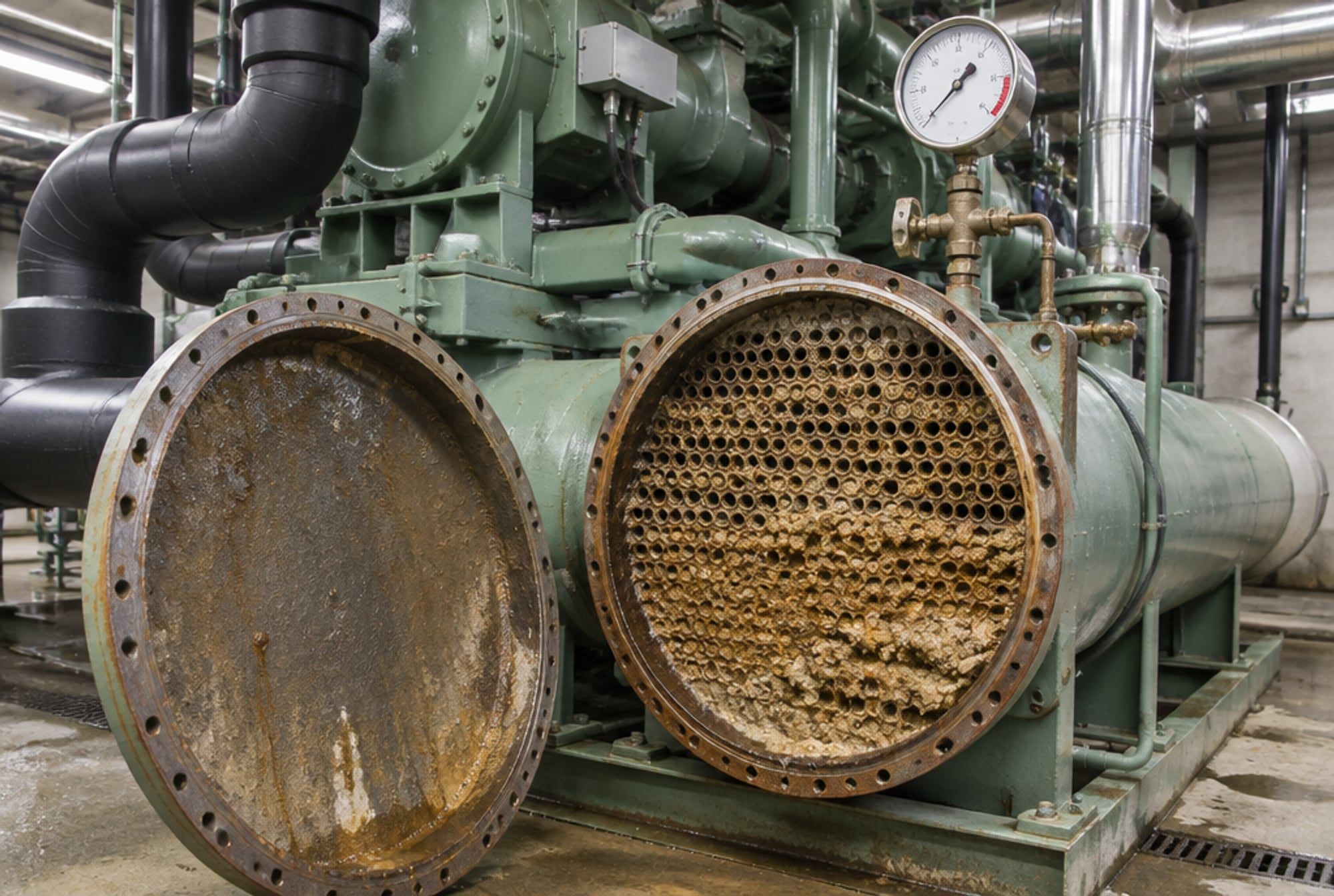
- Fouled condenser or evaporator tubes (approach temperatures rise)
- Low refrigerant charge or non-condensables
- Compressor wear
- Poor control sequences and setpoints
- Dirty air-cooled condenser coils
The routine checks in chiller maintenance checklist are the practical way to keep a machine close to its rating. Trending kW per ton from a power meter and BTU meter is an inexpensive way to see drift early.
Frequently asked questions
What is a good kW per ton for a chiller?
It depends on type and conditions. As a rough guide, a modern water-cooled centrifugal or screw chiller at full load might fall around 0.5 to 0.65 kW/ton, and an air-cooled chiller around 0.9 to 1.2. Part-load and IPLV values are often lower than full-load values. Always compare against the certified ratings of specific models.
Is a higher EER or a higher COP better?
Higher is better for both. A higher EER or COP means more cooling per unit of electricity. For kW per ton, it is the opposite: lower is better.
Why does my chiller use more power than its rating?
Common reasons include higher condenser temperatures than the rating assumed, fouled tubes, low refrigerant charge, operation far from the design load, or comparing a plant-level measurement with a chiller-only rating. Trend data over time helps separate a real problem from a mismatch in conditions.
SpecServis engineers in Ukraine work with industrial chillers and refrigeration plants. We are planning to enter the Central Texas market and are looking for technicians, partners and a company to buy. See our open positions or partnership options.