By Tamika Brooks · Updated August 16, 2026 · 6 min read
Short answer
Chiller upkeep works best as a routine: daily readings logged and compared with the machine's own history, monthly visual and functional checks, and annual inspections of tubes, oil, controls, safeties, refrigerant leaks and water treatment. Trends in approach temperatures, pressures, amps and oil condition show developing problems long before a trip.
A chiller keeps running well when someone reads it regularly, logs the numbers and acts on trends. This checklist is written for in-house facility teams. It groups tasks by frequency and explains why each matters. Always follow the manufacturer’s operation and maintenance manual first, and the safety rules for your site; this guide supplements them. If you want a refresher on the machine itself, see how a chiller works.
What should be logged every day or every shift?
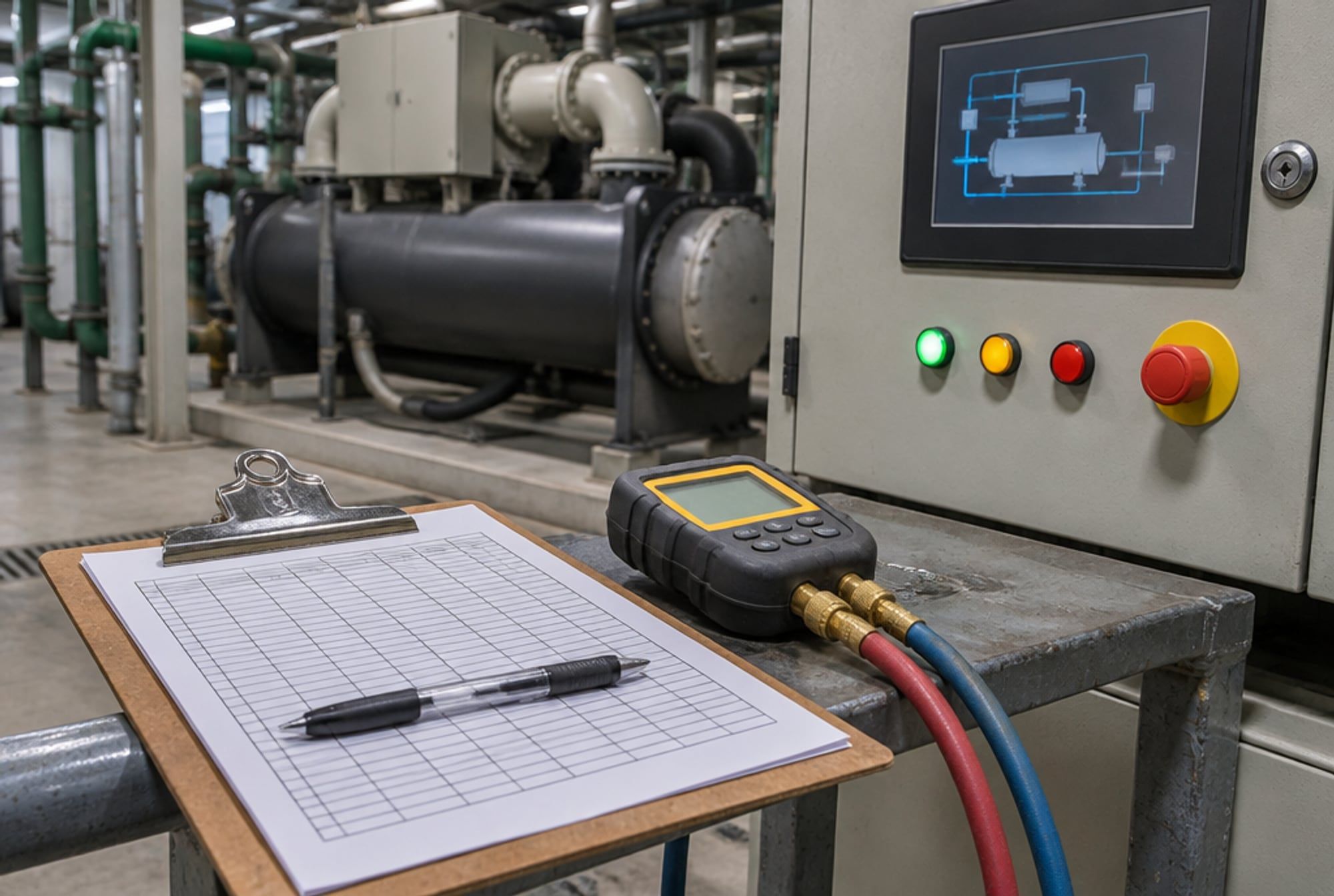
Record the same values at similar load, ideally at the same time each day:
- Chilled water entering and leaving temperatures, and flow if metered.
- Condenser water entering and leaving temperatures (water-cooled) or outdoor air temperature (air-cooled).
- Evaporator and condenser refrigerant pressures and saturation temperatures.
- Compressor amps or percent load, and slide valve, vane or speed position.
- Oil pressure and oil level.
- Any alarms, trips or unusual noise and vibration.
Look for drift against the machine’s own history at similar conditions. A reading that is acceptable alone can be a warning when it keeps moving in one direction. For how trends point to wear, see five signs a compressor is wearing out.
What are the key temperature checks?
Two numbers summarize heat exchanger health:
- Evaporator approach: leaving chilled water temperature minus saturated refrigerant temperature. A rising approach points to fouling, low charge or poor refrigerant distribution.
- Condenser approach: saturated condensing temperature minus leaving condenser water temperature. A rising approach points to fouled tubes, non-condensables or low water flow.
Each machine has a normal range at a given load. Record the baseline at commissioning or after a cleaning and compare it later.
What should be checked every month?
| Area | Task | Why |
|---|---|---|
| Visual walk-around | Look for oil stains, refrigerant leaks, corrosion, loose guards and damaged insulation | Catches small leaks and wet insulation early |
| Oil | Check level, color and sight glass; note any oil added | Oil loss or dark oil signals a problem |
| Strainers and filters | Check differential pressure and clean as needed | Reduces flow loss and fouling |
| Pumps and motors | Listen, check seals, vibration and temperature | Protects flow and prevents trips |
| Controls | Confirm setpoints, reset values and sensor readings agree | Avoids drifting control and false alarms |
| Air-cooled units | Inspect condenser coils and fans | Dirty coils raise head pressure |
| Cooling tower (if used) | Check basin, fill, drift eliminators, float valve and fans | Affects condenser water temperature |
| Water treatment | Test conductivity, pH, inhibitor level and biocide | Controls scale, corrosion and microbial growth |
What should be done every year?
An annual inspection should cover:
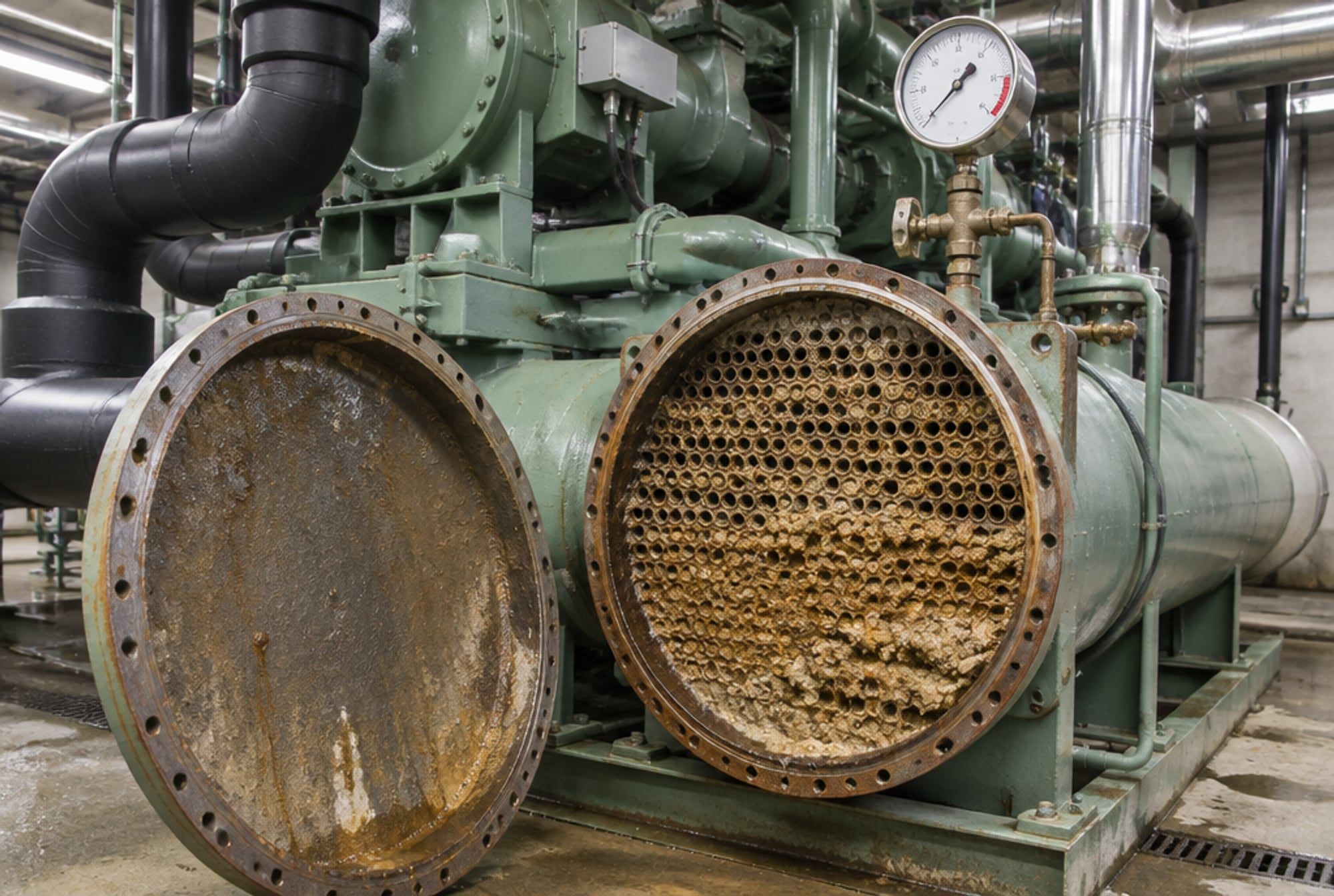
- Tube condition. Inspect and clean condenser tubes if the approach has risen. Eddy-current testing on a schedule can reveal wall loss in evaporator and condenser tubes.
- Refrigerant leak checks. Use an electronic detector and record results. Leak repair rules under the EPA AIM Act apply to appliances above certain charge sizes, so keep records and follow current requirements.
- Oil and filters. Take an oil sample and analyze it for wear metals, moisture and acid; change oil and filters according to the manufacturer and the test results. See what oil analysis tells you.
- Electrical. Check connections for heat and tightness, starter contacts, motor insulation resistance and phase balance.
- Safety devices. Test high-pressure, low-pressure, low oil pressure, freeze protection, flow switches and motor overloads. Check relief devices according to code.
- Controls and calibration. Verify sensors and transducers against calibrated instruments; confirm unloading, staging and alarm settings.
- Vibration. Measure compressor and motor vibration and compare with earlier readings.
- Water side. Check chilled water and condenser water flow, pump performance, glycol concentration if used and inhibitor levels.
- Documentation. Update the logbook, record the baseline conditions and file reports.
What causes the most common problems?
| Symptom | Likely causes | What to check first |
|---|---|---|
| Rising head pressure | Fouled condenser, low water flow, hot air recirculation, non-condensables | Condenser approach, tower, coils and fans |
| Falling chilled water capacity | Low charge, fouled evaporator, flow problems, compressor wear | Evaporator approach, refrigerant level, amps |
| Freeze trips | Low flow, low load, setpoint, low charge | Flow switch, pump, strainers, glycol level |
| High oil temperature | Oil cooler problems, high discharge temperature | Cooler water flow, compressor load |
| Frequent short cycling | Oversized load swings, control settings, low system volume | Setpoints, buffer tank, staging |
For the causes of high-pressure trips and freeze protection, check the manufacturer’s service literature. For motor and winding failures, see compressor burnout: causes and testing.
How does air-cooled maintenance differ from water-cooled?
Air-cooled chillers need clean coils and working fans, and they lose capacity quickly in hot weather if the coils are dirty. Water-cooled chillers need tube cleaning, tower upkeep and water treatment, including a Legionella management program. The trade-offs are described in air-cooled vs water-cooled chillers.
What records should you keep?
- Daily and monthly logs, with dates and initials.
- Oil analysis reports and oil change records.
- Leak check results, refrigerant added and leak repairs.
- Tube cleaning and inspection reports.
- Alarm and trip history with causes found.
- Water treatment test results.
- Nameplate data and manuals; see how to read a compressor nameplate.
Good records are the quickest way to spot slow changes and to show an auditor or manufacturer what was done.
Frequently asked questions
How often should a chiller be serviced?
Follow the manufacturer’s schedule. In practice that means daily or shift readings, monthly checks and an annual inspection, with more frequent attention for critical or heavily loaded machines.
What is a normal approach temperature?
It depends on the machine, load and design. Many manufacturers specify a design approach in the range of a few degrees Fahrenheit. Use the design data and your own baseline.
Do small chillers need a maintenance routine too?
Yes, though the tasks are simpler: clean coils or strainers, check water quality, log readings and test safeties.
SpecServis engineers in Ukraine work with chillers and refrigeration plants. We are planning to enter the Central Texas market and are looking for technicians, partners and a company to buy. See our open positions or partnership options.