By Priya Raman · Updated August 5, 2026 · 6 min read
Short answer
Water-cooled chillers are more efficient and last longer but need a cooling tower, water treatment and a steady water supply. Air-cooled chillers are simpler and use no water, but they lose capacity and efficiency in high heat. In hot, water-conscious regions like Central Texas the choice depends on load size, water availability and how many hours the plant runs.
The difference between an air-cooled and a water-cooled chiller is how it gets rid of heat. Air-cooled chillers push it into outdoor air with fans. Water-cooled chillers pass it to condenser water, which a cooling tower then cools by evaporation. Water-cooled machines win on efficiency and lifespan; air-cooled machines win on simplicity and water use. For basics on the cycle itself, see how a chiller works.
What is the difference in how they work?
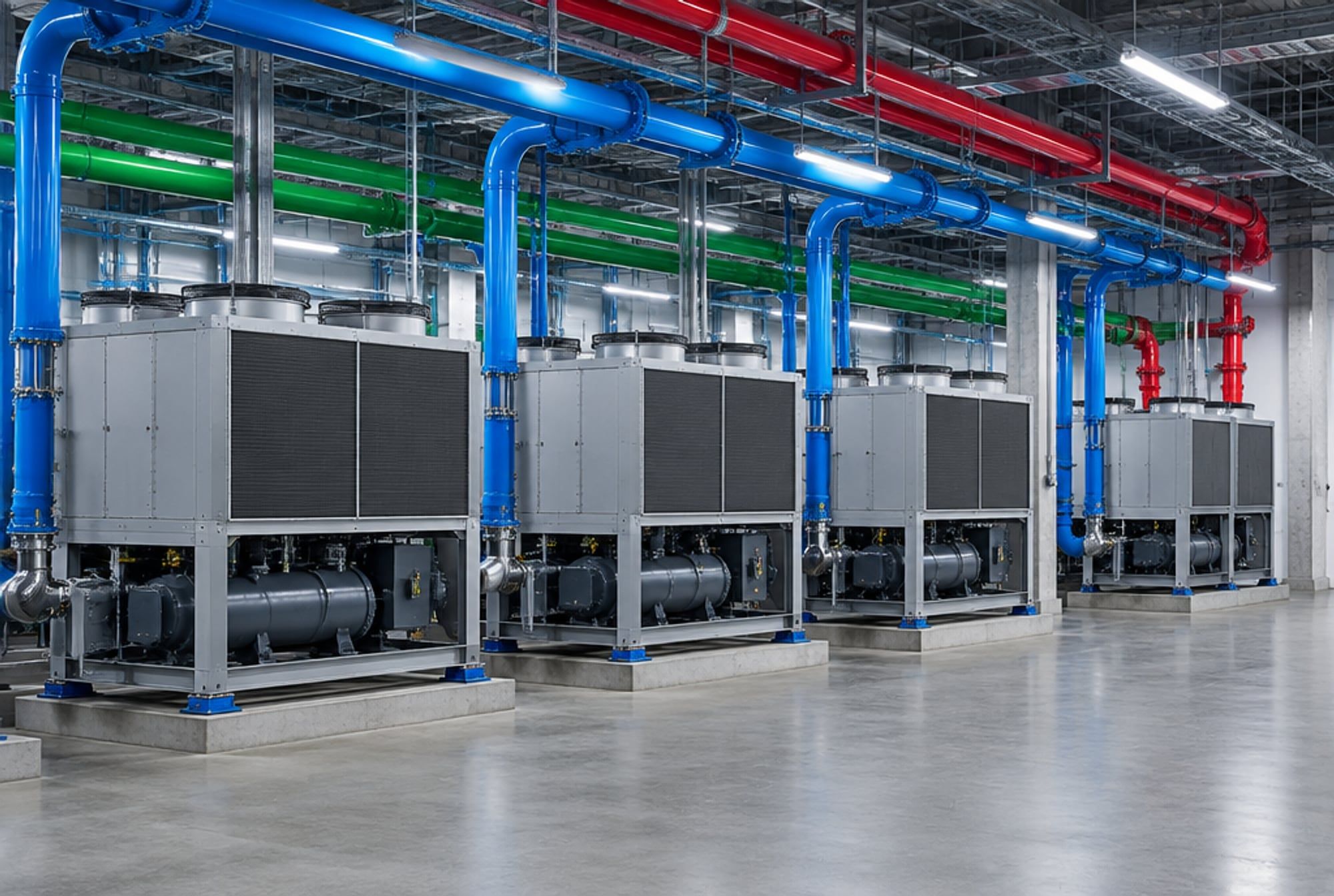
Air-cooled: the condenser is a coil bank with fans, built into the chiller and installed outdoors. Refrigerant condenses against outdoor air, so the condensing temperature follows the outdoor temperature.
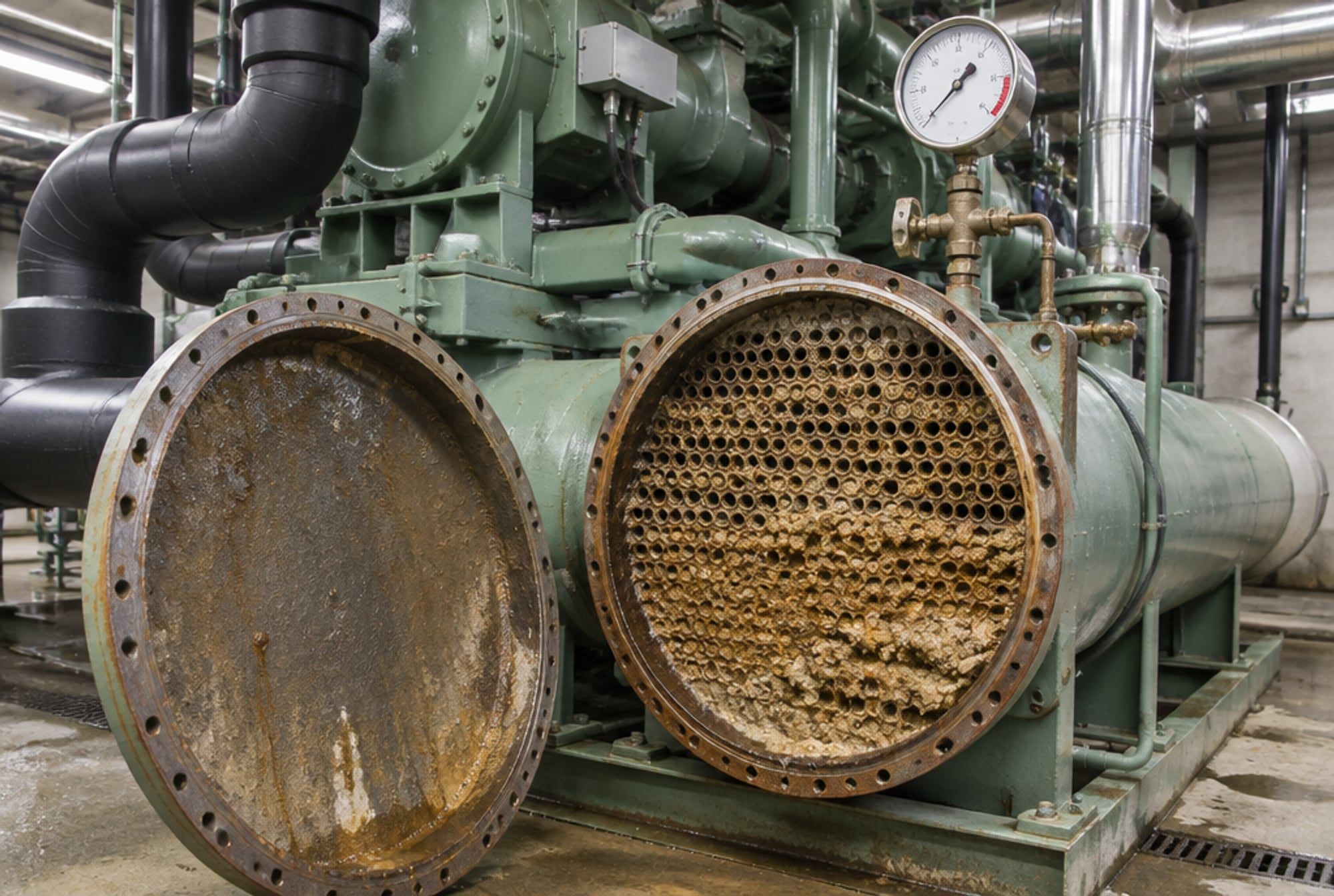
Water-cooled: the condenser is a shell-and-tube heat exchanger inside the chiller. Condenser water circulates between it and a cooling tower. The tower brings the water close to the outdoor wet-bulb temperature, which is lower than the dry-bulb temperature, so the refrigerant condenses at a lower pressure and the compressor works less.
How do they compare?
| Factor | Air-cooled | Water-cooled |
|---|---|---|
| Typical full-load efficiency | roughly 0.9–1.3 kW/ton | roughly 0.5–0.7 kW/ton |
| Water use | none for heat rejection | evaporation, drift and blowdown at the tower |
| Extra equipment | none | cooling tower, condenser pumps, water treatment |
| Capacity range | small to mid-size (up to about 500 tons in many lines) | mid-size to very large |
| Installation | outdoors, rooftop or slab | chiller indoors in a plant room, tower outdoors |
| Heat sensitivity | capacity drops as outdoor temperature rises | less sensitive, follows wet-bulb |
| Typical service life | shorter, commonly cited 15–20 years | longer, commonly cited 20–25 years |
| Maintenance | coil cleaning, fan motors | tube cleaning, tower, water treatment, Legionella program |
Treat the numbers as ranges. Actual values depend on the model, refrigerant, rated conditions and part-load performance, so use the manufacturer’s data.
How does Texas heat change the decision?
- Capacity at high ambient. An air-cooled chiller selected at 95°F outdoor air will deliver less when Austin sees 105°F afternoons. Specify for the real design temperature, and check the manufacturer’s high-ambient option.
- Water supply and cost. Cooling towers evaporate water. In a state where data center and industrial water use is under public scrutiny, a plant’s water source and cost belong in the decision, not after it.
- Peak electric demand. Air-cooled chillers draw more kW per ton at the hottest hours, which are also the hours of highest grid demand. A plant with demand charges can feel that on the bill.
- Footprint. Air-cooled units need clear space for airflow. Water-cooled plants need a mechanical room and tower space.
When is air-cooled the better choice?
- Smaller loads, roughly under a few hundred tons.
- No suitable water supply, or no appetite for water treatment and a Legionella management program.
- Sites with limited operating staff.
- Projects where the lowest installed cost matters more than the lowest running cost.
When is water-cooled the better choice?
- Large, steady loads that run most hours of the year, such as hospitals, large offices and data centers.
- Sites where energy cost is the biggest part of lifetime cost.
- Plants with trained staff or a service contract that covers the tower and water treatment.
Are there hybrid options?
Yes. Some plants use air-cooled chillers with evaporative pre-cooling, or water-cooled chillers with a dry cooler in winter for free cooling. Variable-speed compressors and fans improve part-load efficiency on either type. Data centers often combine approaches; see data center cooling explained.
What should you compare beyond efficiency?
Efficiency numbers are only part of the decision. A practical comparison also covers four other items.
Footprint and location. Air-cooled chillers need clear airflow around the coils and are usually placed outdoors or on a roof. Water-cooled plants need a mechanical room plus space for cooling towers and pumps.
Water and treatment. A water-cooled plant depends on a steady water supply and a treatment program. Scale, biological growth and blowdown all have a cost. See cooling tower basics for what that program involves.
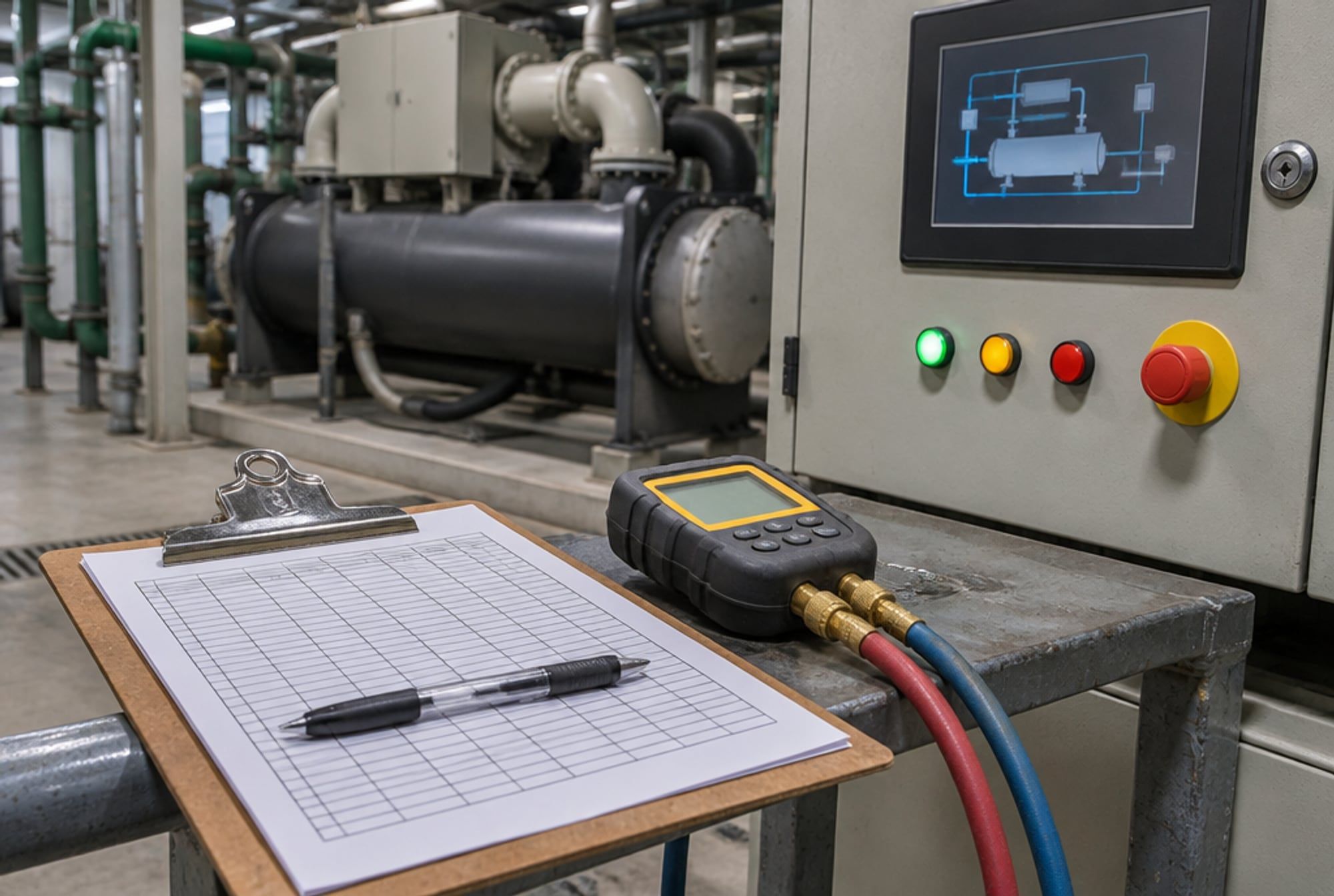
Part-load behavior. Most chillers run at part load most of the year, so compare the integrated figures, not only full-load numbers. The kW per ton and IPLV guide explains how to read them.
Life and replacement cost. Water-cooled machines are often installed indoors and can last longer, but the tower and pumps add cost. The chiller lifespan article covers typical ranges and what shortens them.
Put all four next to the first-cost comparison. A cheaper air-cooled unit can lose on lifetime cost in one building and win in another, depending on water prices, load profile and available space.
Frequently asked questions
Which is cheaper, air-cooled or water-cooled?
Air-cooled usually costs less to install at smaller sizes. Water-cooled often costs less to run at larger sizes. A life-cycle comparison with local electric and water rates is the only reliable answer.
Do air-cooled chillers work in Texas summers?
Yes, when they are selected for the real design temperature. Plan for reduced capacity at the extreme peak and check high-ambient and fan-control options.
Does a water-cooled chiller always need a cooling tower?
Most do. Some sites use a closed-circuit dry cooler or a once-through water source where regulations allow, but those are exceptions.
If you design, run or service chiller plants in Central Texas and like the engineering behind this, we would like to hear from you. See our open positions or partnership options.