By Priya Raman · Updated October 31, 2026 · 6 min read
Short answer
A cooling tower rejects heat from a water-cooled chiller by evaporating a small part of the circulating water. That evaporation concentrates minerals, which causes scale and corrosion, and warm water invites microbial growth including Legionella. Water treatment, regular monitoring and a written water management program keep the system efficient and lower health risk.
A cooling tower cools the condenser water of a water-cooled chiller by letting a small portion of it evaporate into moving air. The rest of the water leaves cooler and returns to the chiller. Because evaporation leaves minerals behind, the water must be treated and bled off, and because the water is warm and exposed to air, it must be managed to limit microbial growth, including Legionella bacteria. The practical answer: monitor, treat and document, following a water management program built on ASHRAE Standard 188 and CDC guidance.
How does a cooling tower work?
Warm condenser water from the chiller is sprayed over a fill, a plastic or wood surface that spreads the water into thin films. A fan moves air through the fill, either pulling it (induced draft) or pushing it (forced draft). A small fraction of the water evaporates, and that evaporation removes heat from the rest. The cooled water collects in the basin and is pumped back to the condenser. For where this fits in the cycle, see how a chiller works and water-cooled chillers: components and applications.
Main parts you will see:
- Fill: large surface area for heat and mass transfer.
- Drift eliminators: baffles that capture water droplets before they leave with the air.
- Basin and sump: collects cooled water; holds the float valve for make-up water.
- Fans and motors: move the air; often controlled by a variable frequency drive.
- Distribution system: nozzles or troughs that spread the hot water evenly.
- Blowdown and make-up lines: remove concentrated water and replace what was lost.
Why does scale form in a cooling tower?
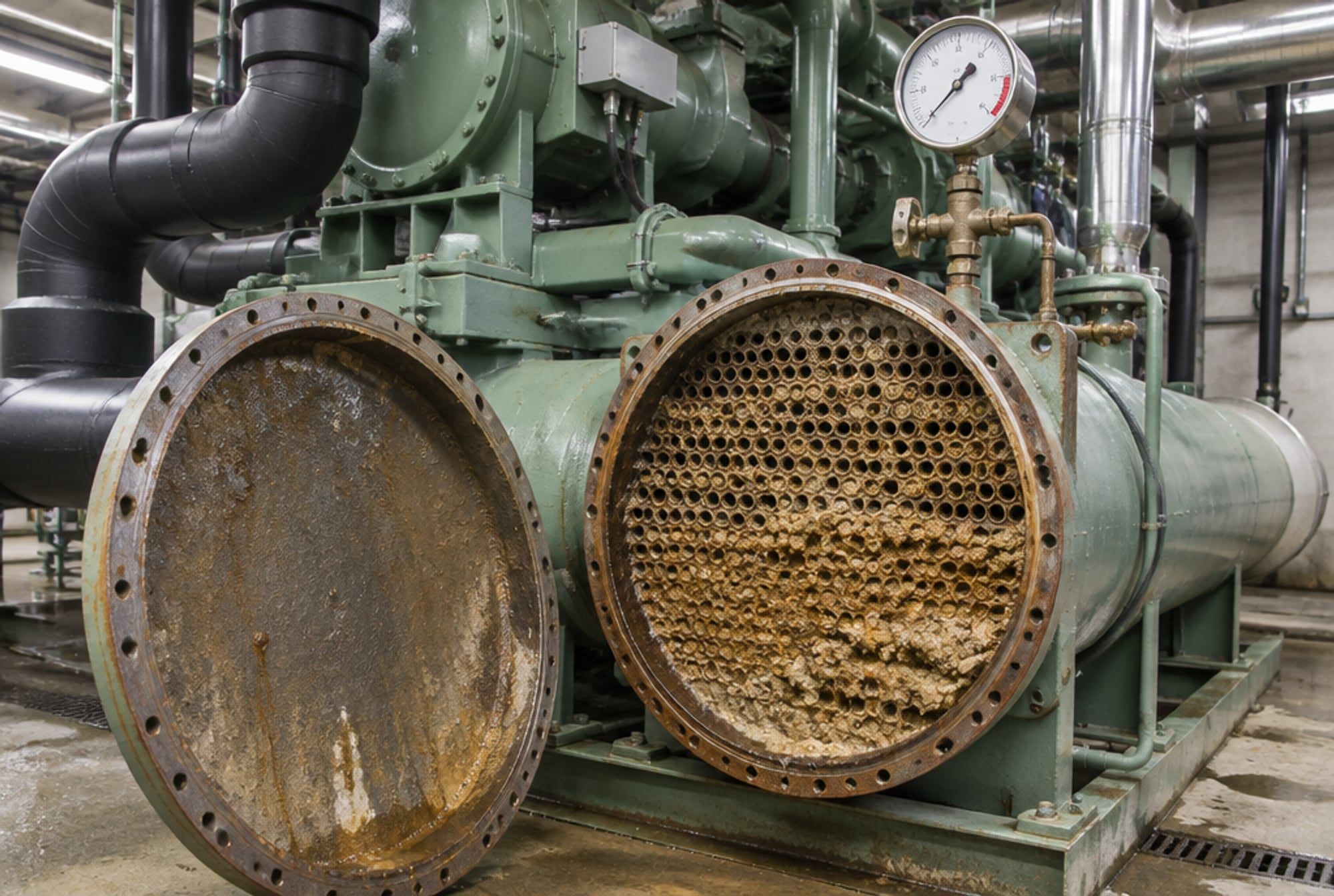
Evaporation removes pure water vapor, so dissolved minerals such as calcium and magnesium stay behind and become more concentrated. When they exceed what the water can hold, they come out of solution as scale on the hottest surfaces, usually the condenser tubes. Scale insulates the tube, so the chiller must work against a higher condensing pressure and uses more energy for the same cooling. The idea is explained further in chilled water system water treatment basics.
The key control is the number of cycles of concentration, which compares the dissolved solids in the tower water with those in the make-up water. More cycles saves water but raises scaling and corrosion risk. The right target depends on the make-up water quality and the treatment program, so it is set by a water treatment specialist from test results rather than copied from another site.
What are biofouling and corrosion?
Warm, sunlit, nutrient-rich water grows algae and bacteria. They form a slime layer called biofilm on fill, basin and tube surfaces. Biofilm blocks heat transfer, restricts flow and shelters bacteria from disinfectants. Corrosion is the other side: untreated water, low pH or high chlorides can eat steel, copper and galvanized surfaces, leading to leaks and early replacement of equipment. Scale, corrosion and biofouling interact, which is why a treatment program addresses all three together.
What is the Legionella risk and how is it managed?
Legionella is a bacterium that grows in warm water between roughly body temperature and the temperatures common in tower basins. People get Legionnaires’ disease by breathing in fine water droplets that contain the bacteria; it is not spread by drinking the water. Cooling towers create droplets by design, so they are treated as a place where risk should be actively managed.
The widely used framework is ASHRAE Standard 188, which calls for a documented water management program for building water systems, and the related ASHRAE guideline for implementing it. CDC publishes a toolkit that walks building owners through the same steps. In general terms, a program includes:
- A team and a diagram of the water systems, including towers.
- An analysis of where conditions could allow Legionella to grow.
- Control measures, such as maintaining disinfectant residual, controlling temperature, limiting stagnation and keeping drift eliminators in good condition.
- Monitoring limits and what corrective action follows if they are exceeded.
- Verification and documentation, including records of tests and actions.
Rules vary by jurisdiction, and some cities and states add their own requirements, so check the current local rules and the source documents rather than relying on a general article.
What does water treatment include?
| Element | Purpose | Typical check |
|---|---|---|
| Make-up water | Replaces evaporation, drift and blowdown | Quality, hardness, flow measurement |
| Blowdown control | Limits concentration of dissolved solids | Conductivity |
| Scale and corrosion inhibitors | Keep minerals in solution and protect metal | Inhibitor residual, corrosion coupons |
| Biocides | Control bacteria and algae | Oxidizer residual, microbiological tests |
| Filtration or side-stream | Removes suspended solids and dirt | Differential pressure, turbidity |
| Cleaning and disinfection | Resets heavily fouled or stagnant systems | Visual inspection, record of procedure |
Treatment chemicals have safety and discharge requirements of their own, so handling and disposal follow the product label and local rules.
What routine checks keep a tower in good shape?
- Walk the tower regularly and look at the basin, fill and drift eliminators for debris, algae, damage and uneven flow.
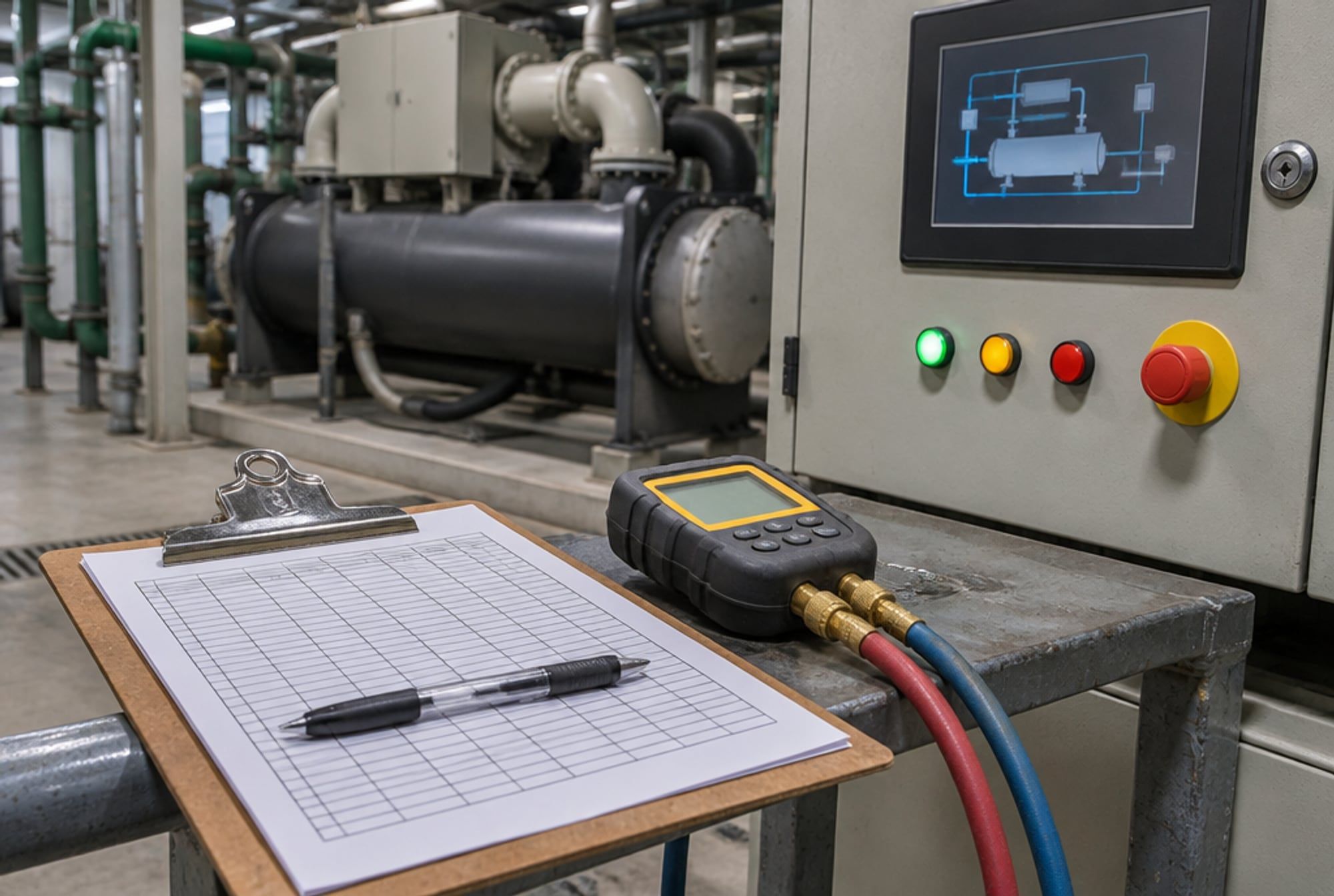
- Read conductivity, pH and treatment residuals on the schedule your program sets, and log them.
- Confirm that the float valve, blowdown and bleed work, since a stuck valve wastes water or causes overflow.
- Check fan and motor condition, belts or gear drives, and vibration switches.
- Plan for idle periods: standing water in a shut down tower is a common cause of microbial growth, so the program should say how to handle seasonal shutdowns and restarts.
- Record every adjustment. Records are the main evidence that a program is actually working.
Frequently asked questions
Can cooling tower water make people sick?
Yes, if Legionella grows and droplets from the tower are inhaled. Risk is managed with a water management program, disinfectant control, good drift eliminators and prompt corrective action when monitoring results are off.
How often should cooling tower water be tested?
It depends on the program. Many sites check conductivity and biocide residual very often and run microbiological tests on a set schedule. Follow your written program, your water treatment specialist and current local requirements.
Does better water treatment save energy?
Usually, yes. Clean condenser tubes keep condensing pressure lower, so the chiller draws less power for the same load, and a controlled number of cycles also reduces make-up water use.
Treatment programs only work when someone with the right training runs them consistently. SpecServis engineers in Ukraine have worked with water-cooled plants and their auxiliary systems. We are planning to enter the Central Texas market and are looking for technicians, partners and a company to buy. See our open positions or partnership options.