By Yevhen Kovalchuk · Updated September 5, 2026 · 5 min read
Short answer
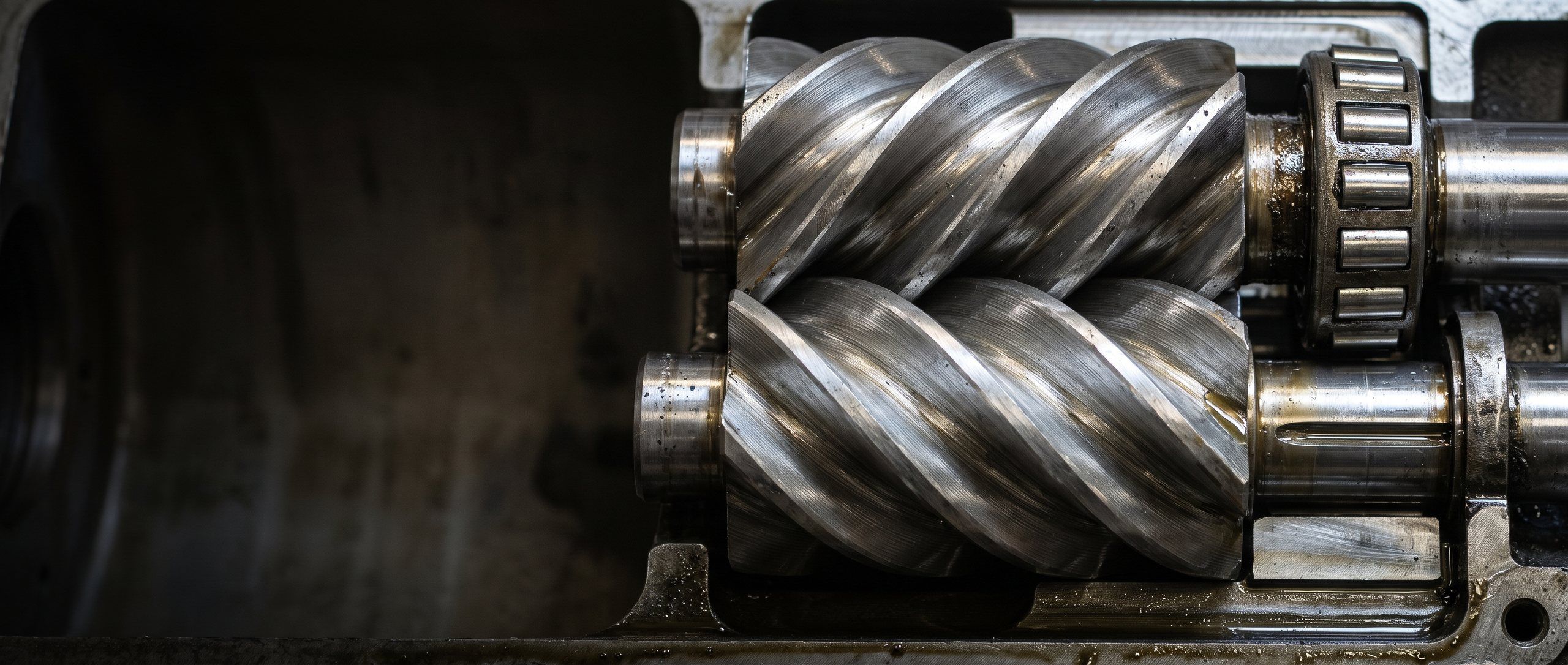
A screw compressor traps refrigerant gas between two meshing helical rotors and squeezes it as the pockets between the lobes shrink on their way to the discharge port. Oil injected into the rotor housing seals the clearances, absorbs heat and lubricates the bearings, while a slide valve matches capacity to the load.
A rotary screw compressor is a positive-displacement machine: every turn of the rotors moves a fixed volume of gas from suction to discharge. Screw machines dominate industrial refrigeration, large ammonia plants and many water-cooled chillers because they run continuously, have few wearing parts and handle high pressure ratios in a single stage.
What happens inside a screw compressor?
Two rotors sit in a close-fitting housing. The male rotor has convex lobes, the female rotor has matching concave flutes, and common lobe combinations include 4/6 and 5/6. In most designs the motor drives the male rotor, and the female rotor follows it.
One compression cycle has three phases:
- Suction. As the rotors unmesh at the suction end, the space between a lobe and a flute opens and fills with gas from the suction port.
- Compression. The rotors keep turning, the pocket is cut off from suction, and the meshing line moves along the rotors toward the discharge end. The pocket gets smaller and the gas pressure rises.
- Discharge. The pocket reaches the discharge port and the compressed gas leaves for the oil separator and the condenser.
Because many pockets are in different stages at the same time, flow is nearly continuous, and there are no suction or discharge valves to break.
Single-screw compressors work on the same principle with a different geometry: one main rotor meshes with two star-shaped gate rotors on opposite sides, which balances the radial loads on the main rotor.
Why do screw compressors need so much oil?
In refrigeration, almost all screw compressors are oil-injected (oil-flooded). Oil is fed into the compression chamber and does three jobs at once:
- Sealing. The rotors never touch each other or the housing. Oil fills the small clearances so that gas does not leak back from high-pressure pockets to low-pressure ones.
- Cooling. Oil absorbs a large part of the heat of compression, which keeps discharge temperatures far lower than the gas alone would reach at the same pressure ratio.
- Lubrication. The same oil supply lubricates the bearings and, on open-drive machines, the shaft seal.
All that oil leaves the compressor with the discharge gas, so every screw package needs an efficient oil separator, an oil cooler and oil filters. Oil cooling can be done by water or glycol heat exchangers, by thermosiphon cooling with refrigerant from the high-pressure receiver, or by injecting liquid refrigerant directly into the compressor.
On ammonia systems this matters even more. Ammonia and conventional refrigeration oils are largely immiscible, so oil that escapes the separator collects in low points of evaporators and vessels and has to be drained.
What is the built-in volume ratio (Vi)?
The discharge port’s position fixes how much the pocket shrinks before it opens. That ratio of suction volume to discharge volume is the built-in volume ratio, or Vi. A higher Vi means more internal compression.
The pressure that the compressor creates internally depends on Vi and the properties of the refrigerant. When that internal pressure matches the actual condensing pressure, the machine runs at its best efficiency. When it does not, energy is wasted:
- Under-compression (Vi too low): the pocket opens before reaching condenser pressure, and high-pressure gas rushes back into it.
- Over-compression (Vi too high): the gas is compressed above condenser pressure and then expands as it leaves, so work was done for nothing.
Older and simpler machines have a fixed Vi chosen for the expected operating conditions, often labeled low, medium and high. Many modern industrial packages have a variable Vi, using a second slide or a movable stop so the controller can track condensing and suction pressures as they change with the season and the load.
How does a screw compressor control its capacity?
The most common method in industrial machines is the slide valve. It is a movable section of the housing under the rotors, on the suction side. When it slides back, part of the gas that entered the rotors returns to suction before it is compressed, so the effective length of the rotors and the capacity both drop. The slide valve allows smooth, stepless control down to a small fraction of full load.
Other methods include lift valves, suction throttling and variable-speed drives. Because slide-valve efficiency drops at deep part load, plants with several screws usually run as many machines as possible fully loaded and trim with one.
Some screws also have an economizer port, which lets gas from an intermediate-pressure flash vessel or subcooler enter a closed pocket partway through compression. This raises capacity and efficiency at high pressure ratios without a second stage.
How does a screw compare with a reciprocating compressor?
| Feature | Screw compressor | Reciprocating compressor |
|---|---|---|
| Compression | Continuous, rotary | Intermittent, piston strokes |
| Valves | None | Suction and discharge valves |
| Capacity control | Slide valve or speed, stepless | Cylinder unloading or speed, stepped |
| Tolerance to liquid slugs | Relatively high | Low; liquid can break valves and rods |
| Oil handling | Large oil flow, separator and cooler required | Crankcase lubrication, small carryover |
| Typical wear points | Bearings, shaft seal, slide valve | Valves, rings, rods, bearings |
What wears out in a screw compressor?
The rotors themselves rarely wear if the oil is clean. The parts with a finite life are the bearings, the shaft seal on open-drive machines and the slide-valve mechanism. Radial loads are usually carried by roller or sleeve bearings, and the axial thrust from the pressure difference is taken by angular-contact ball bearings at the discharge end, sometimes assisted by a balance piston.
As thrust bearings wear, the rotors move toward the discharge end housing and the clearance there shrinks. That is why manufacturers specify periodic measurement of rotor end float, and why vibration trending and oil analysis are useful early warnings. Our team in Ukraine maintains MYCOM screw compressors on an ammonia system at a cheese plant, and on machines like these, oil condition and bearing measurements are the records that matter most.
If you work on screw compressors and industrial refrigeration in Central Texas, we would like to meet you. See our open positions or partnership options.
Where can you go deeper?
This article covers the basic mechanism. Related topics help put it in context. To compare screws with other designs, read the refrigeration compressor types guide and screw vs. scroll compressors. To understand the maintenance side, see five signs a compressor is wearing out and what oil analysis tells you, since oil condition is central to screw compressor life. For ammonia plants, where screw compressors are very common, ammonia refrigeration system basics shows how the compressor fits into the whole system.
Frequently asked questions
Are screw compressors more efficient than reciprocating compressors?
It depends on the operating point. A screw running near full load with a Vi matched to the system is very efficient, but its efficiency falls at deep part load. Reciprocating machines keep reasonable efficiency at part load by unloading cylinders, so the best choice depends on the load profile.
Why is the oil temperature so important on a screw compressor?
Oil that is too hot loses viscosity, which reduces sealing and the film strength in the bearings. Oil that is too cold can carry too much dissolved refrigerant, which also thins it. Manufacturers give a target oil injection temperature range, and the oil cooler controls keep the oil inside it.
Can a screw compressor run on both ammonia and HFC refrigerants?
Many rotor designs are offered for both, but the package is different. Ammonia machines are usually open-drive and built without copper or brass in contact with the refrigerant, and they typically use oils that do not mix with the refrigerant. HFC machines are often semi-hermetic and use polyolester (POE) oil that is miscible with the refrigerant.