By Tamika Brooks · Updated August 31, 2026 · 6 min read
Short answer
A glycol chiller cools a water-glycol mix instead of plain water so it can run below 40°F without freezing. Propylene glycol is the usual choice around food and drink; ethylene glycol transfers heat slightly better but is toxic. More glycol means more freeze protection, but also thicker fluid, lower heat transfer and higher pump power, so the concentration should be the lowest that safely covers the lowest temperature.
A glycol chiller is a chiller that circulates a mix of water and glycol, an antifreeze, so the fluid can run at or below 32°F without turning to ice in the evaporator or pipes. Breweries, dairies, food plants, ice rinks and many process lines use them. The refrigeration cycle is the same as in any chiller (see how a chiller works); the difference is the fluid, and the fluid changes capacity, pumping power and maintenance.
Why use glycol instead of water?
Water freezes at 32°F, and an evaporator that runs near that point risks ice forming on the tubes. Ice can restrict flow and, in a shell-and-tube evaporator, rupture tubes. Glycol lowers the freezing point so the chiller can supply fluid at, for example, 25°F to 30°F, which is a common range for fermentation and many process uses. Glycol also protects outdoor piping and air-cooled chillers during cold snaps.
Propylene glycol or ethylene glycol?
| Factor | Propylene glycol (PG) | Ethylene glycol (EG) |
|---|---|---|
| Toxicity | Low; food-grade types exist | Toxic if swallowed |
| Typical use | Food, beverage, pharma, occupied buildings | Industrial loops with no food contact risk |
| Heat transfer | Somewhat lower | Somewhat better |
| Viscosity at low temperature | Higher, so more pump power | Lower |
| Cost | Usually higher | Usually lower |
Vendor comparisons report a heat transfer penalty for both fluids versus plain water, with PG typically worse than EG at the same concentration. At 50% mixes, one manufacturer comparison shows about a 5% loss for EG and about a 12% loss for PG; other sources give wider ranges. Use the fluid manufacturer’s data for your exact mix. Where a leak could reach food or drinking water, most plants choose PG, and local codes may require it.
How much glycol do you need?
Freeze protection rises with concentration, but only up to a point. Rough freeze points from common charts:
| Glycol by volume | Approx. freeze point, EG | Approx. freeze point, PG |
|---|---|---|
| 20% | about 18°F | about 20°F |
| 30% | about 4°F | about 8°F |
| 40% | about −12°F | about −6°F |
| 50% | about −34°F | about −28°F |
These are approximations and differ by source. Two practical rules follow:
- Size the mix for the lowest fluid temperature in the system, with a margin. The evaporator surface can be colder than the leaving fluid, so many designers set the freeze point 10°F or more below the lowest refrigerant-side temperature.
- Do not overdo it. Dow and others advise staying at or below about 50% to 60% glycol. Above that, viscosity and heat transfer penalties grow quickly.
Also note that “burst protection” and “freeze protection” are different. Burst protection stops pipes rupturing when slush forms; freeze protection keeps fluid free-flowing. A chiller evaporator needs freeze protection.
What does glycol do to chiller performance?
Compared with water, a glycol mix has lower specific heat and higher viscosity. In practice:
- Capacity. The chiller delivers less capacity at the same leaving fluid temperature, and you need more flow for the same load.
- Pump energy. Higher viscosity raises pressure drop, especially cold, so pumps work harder.
- Heat exchangers. Surface coefficients fall, so approach temperatures widen.
- Sizing. Chiller and pump selections must use glycol-corrected data. Selecting on water data is a common mistake; see industrial chillers: types and selection.
How should you maintain glycol?
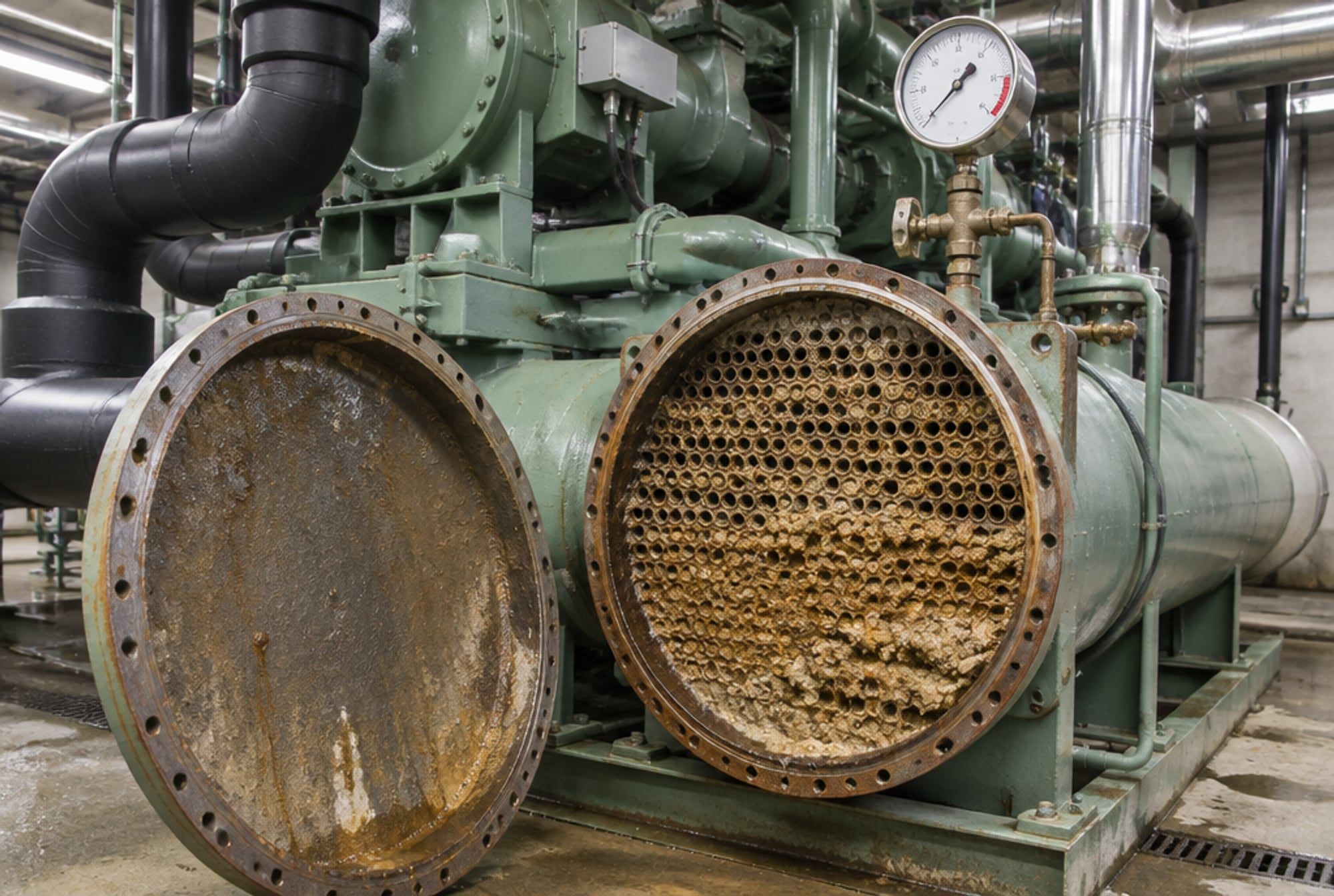
Glycol is not a fill-and-forget fluid. Inhibitors protect metal from corrosion, and they get used up.
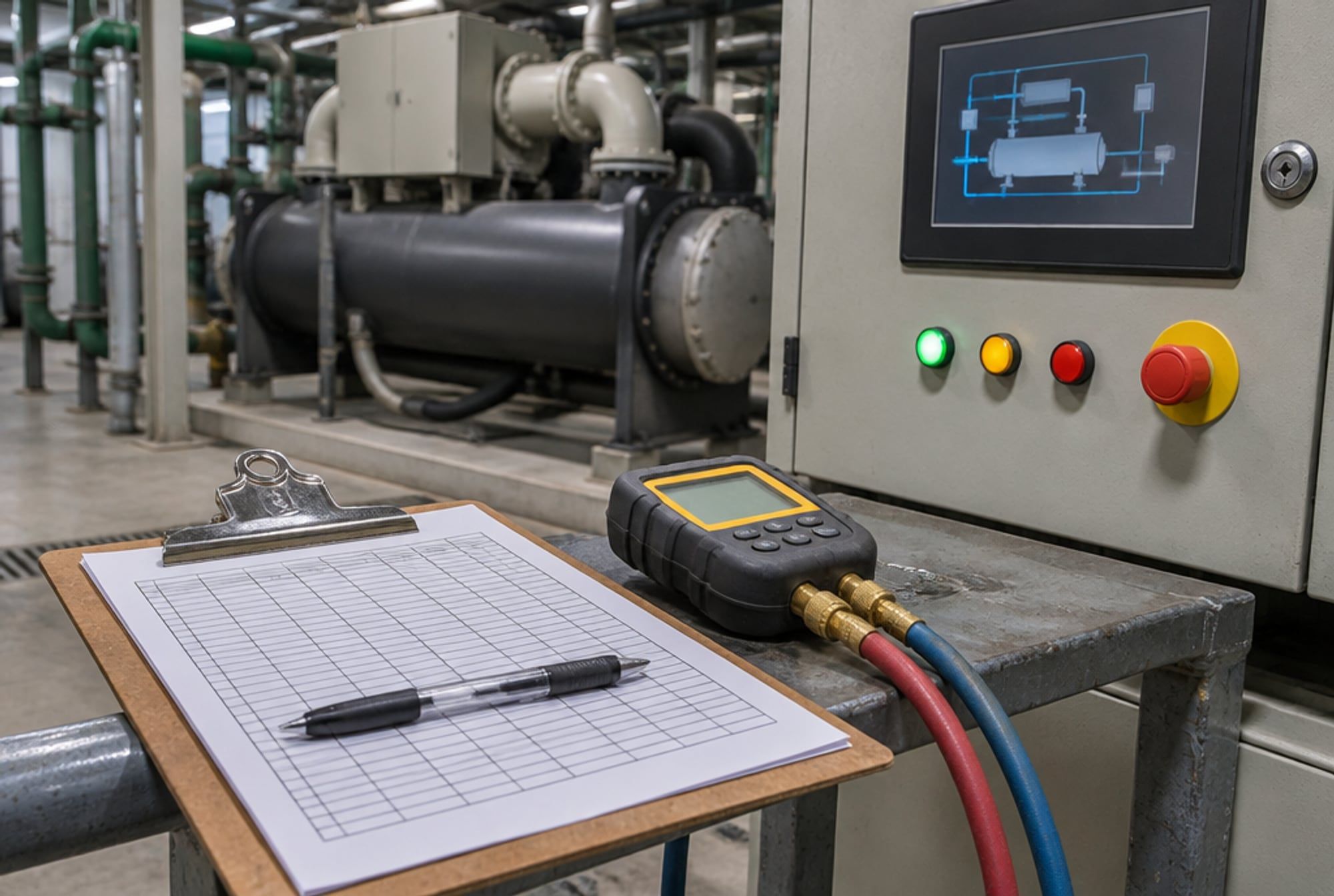
- Check concentration with a refractometer or hydrometer, at least annually and after any leak or top-up.
- Test pH and reserve alkalinity. Many suppliers recommend a pH in roughly the 8 to 10 range, and falling pH shows the inhibitors are depleted or the glycol is breaking down into acids.
- Look for contamination: dark color, odor, sludge, iron or copper in a lab report.
- Use the right water for mixing, since hard water or chlorides raise corrosion risk.
- Avoid galvanized pipe and mixed inhibitor chemistries; zinc and some inhibitors react.
- Keep air out, because oxygen speeds degradation, and avoid overheating the fluid.
- Replace the fluid when testing shows it is exhausted; topping up with water thins the mix.
Good plants record glycol test results next to chiller logs, so trends are visible. That is the same habit that makes compressor wear visible early.
Where are glycol chillers used?
- Breweries and wineries: cooling fermenters and conditioning tanks, often at roughly 25°F to 32°F supply.
- Dairies and food plants: chilling product, wash water and process loops.
- Plastics and chemical processes: tight temperature control on molds and reactors.
- Ice rinks and cold storage: low-temperature secondary loops.
- Outdoor air-cooled chillers in cold climates, where glycol protects the water side in winter.
Texas plants may need glycol less for winter protection and more for process temperatures below 40°F. See air-cooled vs water-cooled chillers for how heat rejection affects the choice.
Frequently asked questions
Can I use car antifreeze in a chiller?
No. Automotive coolant has different inhibitors and is toxic EG. Use industrial glycol with an inhibitor package intended for chillers and the right type for the application.
How often should glycol be changed?
There is no fixed interval. Test it, and replace or re-inhibit when concentration, pH, reserve alkalinity or contamination are out of range. Well-kept systems can run many years.
Does glycol hurt chiller efficiency?
It reduces heat transfer and raises pump power, so the system uses more energy than the same load on plain water. The effect is smaller if you hold the concentration at the minimum needed.
SpecServis engineers in Ukraine have worked on glycol cooling for food and beverage producers. We are planning to enter Central Texas and are looking for technicians and partners. See our open positions or partnership options.