By Priya Raman · Updated August 8, 2026 · 7 min read
Short answer
Texas does not have a single statewide mechanical code for commercial buildings. Each city or county adopts a model code, commonly the International Mechanical Code (IMC) or the Uniform Mechanical Code (UMC), by ordinance and then amends it, so Austin and Dallas can follow different editions with different local changes. The reliable way to know which code applies is to ask the local building department for the adopted edition and amendments for your project.
Texas does not set one mechanical code for every city. Municipalities and some counties adopt a model code by local ordinance, choose the edition, and add their own amendments. That is why the Austin mechanical code and the Dallas mechanical code are not the same document in practice, and why a design that passes plan review in one city may need changes in another. This article is general information, not legal advice or a code interpretation. Confirm the code in force with the local building department for each project.
Why does Texas not have one mechanical code?
Texas leaves most building-code decisions to local governments. State law sets some requirements (for example, energy code provisions and accessibility rules), and the state licenses contractors through TDLR, but the technical code that a city inspector applies to a chiller, a duct or a refrigerant line is usually the one that city’s council adopted. The result is a patchwork:
- Large cities typically adopt a model code on a regular cycle and publish their amendments.
- Smaller towns and unincorporated areas may adopt an older edition, adopt none, or rely on county rules that apply only in limited circumstances.
- The state’s energy code requirements apply separately from the mechanical code, and they also depend on the adopted edition. See what changed in the Texas 2024 mechanical codes for the latest cycle.
For a company that wants to work across Central Texas, this means every new jurisdiction is a new compliance check.
What is the difference between the UMC and the IMC?
Two model codes dominate U.S. mechanical regulation:
| Feature | IMC (International Mechanical Code) | UMC (Uniform Mechanical Code) |
|---|---|---|
| Publisher | International Code Council (ICC) | IAPMO |
| Typical companion codes | International Building Code, International Fuel Gas Code, International Plumbing Code | Uniform Plumbing Code, often used with a local building code |
| Update cycle | Every three years | Every three years |
| Refrigeration safety | Refrigerant provisions in the code, with the ASHRAE 15 safety standard referenced | Refrigeration provisions with its own text and references to ASHRAE 15 |
| Where used in Texas | Widely adopted by cities that follow the ICC family | Adopted by some jurisdictions that prefer the IAPMO family |
The two codes address the same topics (ventilation, combustion air, ducts, equipment installation, refrigeration, access and clearances) but organize and word them differently. Some requirements, such as machinery room rules for refrigeration systems, differ in detail. That is why engineers working across cities need to know which family each city uses and which edition it has adopted.
Both codes refer to ASHRAE Standard 15 for refrigeration safety and ASHRAE 34 for refrigerant classification. The shift toward mildly flammable A2L refrigerants, covered in A2L refrigerants explained, has caused many code updates in recent cycles.
Why can Austin and Dallas differ?
Several reasons stack up:
- Different model-code families or editions. One city may be on a newer edition than another, and a newer edition may add provisions on A2L refrigerants or equipment efficiency.
- Local amendments. Cities routinely delete, change or add sections. Amendments can touch things like permit thresholds, equipment access, condensate disposal or roof equipment screening.
- Different enforcement practices. Inspection checklists and plan review procedures are set by the local building department.
- Other local ordinances. Water-use rules, noise limits and zoning requirements affect equipment like cooling towers and rooftop units even though they are not part of the mechanical code.
None of this makes one city “easier.” It means the safe assumption is that nothing carries over automatically. We do not offer a view here on exactly which edition any city is on today, because it changes with each adoption cycle; the section on checking, below, explains how to find out.
How do you check which code applies to a project?
A practical process:
- Identify the jurisdiction. The city or county where the building sits determines the permitting authority. Addresses just outside a city boundary may be under a different authority than you expect.
- Ask the building department. Request the adopted mechanical code edition, the local amendments, and any administrative rules that apply to your equipment type. Many cities publish this on their development services web pages.
- Check the municipal code. Texas cities usually post their ordinances through a publisher such as Municode. The chapter on building regulations lists the adopted codes and amendments.
- Check related codes. The fire code, energy code, plumbing code and any refrigeration or hazardous-materials provisions can apply at the same time.
- Write it down. Put the code edition and the date you confirmed it into the project file. If the design runs long, check whether a new edition takes effect before the permit is issued.
What does the contractor license have to do with the code?
Not much directly, but both matter. The TDLR license determines who may legally do ACR work in Texas, while the local code determines how the work must be done and inspected. A contractor that holds a license still has to pull permits and pass local inspections where the city requires them. See Texas ACR license types for the license side.
TDLR does not replace the local inspector, and the local inspector does not replace TDLR. A project can face a code problem with the city and a licensing problem with the state at the same time.
Which code topics tend to matter most for chillers and refrigeration?
Whatever the adopted edition, the following topics come up in reviews of chillers, rooftop units and refrigeration systems:
- machinery room requirements for chillers and refrigeration equipment, including ventilation, refrigerant detection and emergency controls, and the way ASHRAE 15 is applied;
- refrigerant type and charge limits, especially for A2L and flammable refrigerants;
- equipment clearances, service access and roof loading;
- relief valve and purge discharge piping;
- condensate, drain and blowdown disposal;
- ammonia systems, which are often governed by the fire code and other standards in addition to the mechanical code; see ammonia refrigeration system basics.
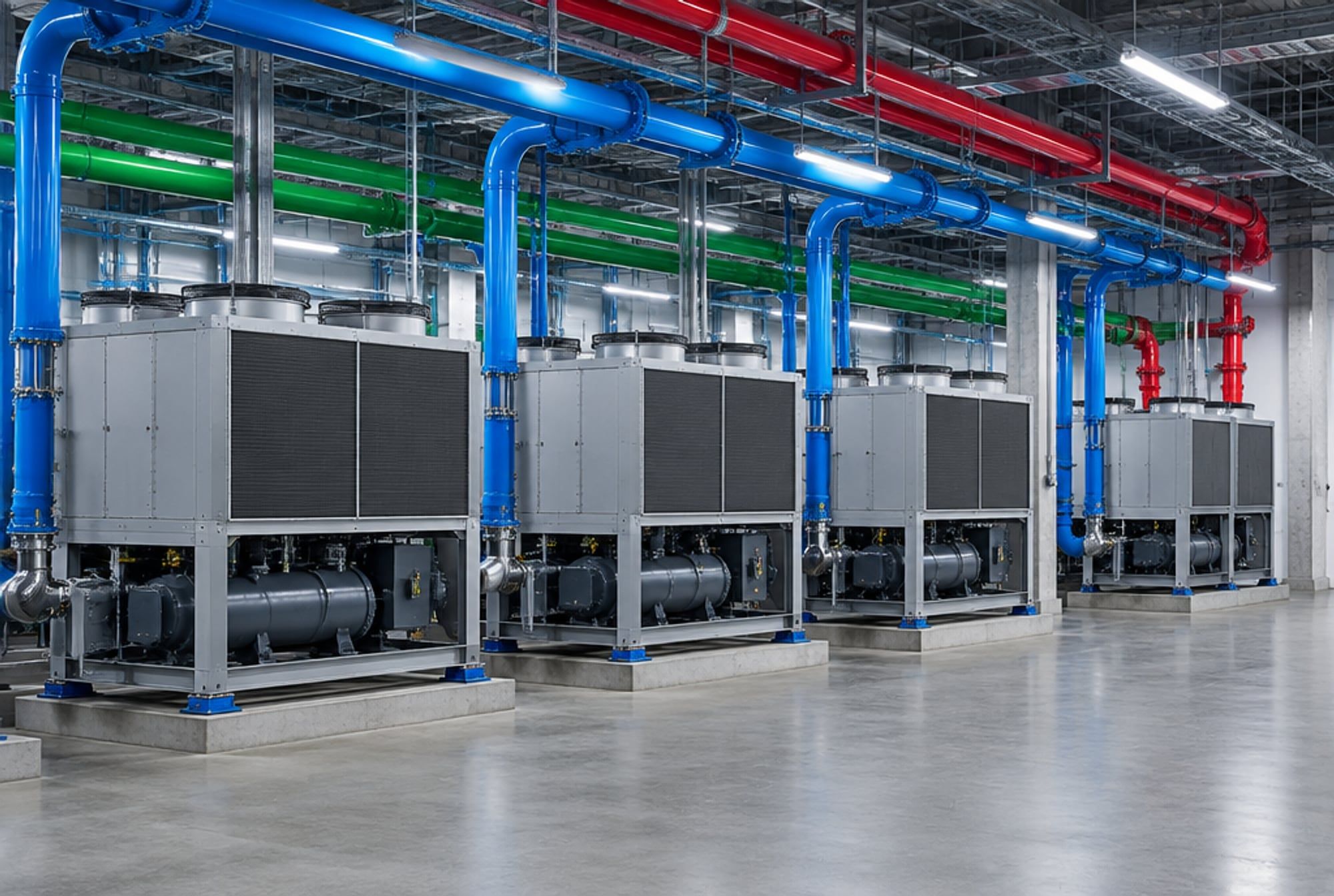
Chiller plants for data centers add power, redundancy and fire-protection questions on top.
How should a company new to Central Texas prepare?
A company entering a new region should build a short jurisdiction file for each city in its target market: code family and edition, key amendments, permit requirements, inspection contacts and typical review time. Revisit the file whenever the city adopts a new edition. Local contractors and engineers who already know the permitting offices are a valuable source of practical knowledge, which is one reason partnership matters more than speed when entering a new market.
Frequently asked questions
Does Texas have a statewide mechanical code?
Not for commercial mechanical work in the way many states do. Cities and some counties adopt codes locally, while the state sets certain requirements, such as energy code provisions, and licenses contractors. Check each jurisdiction.
Is the UMC better than the IMC, or the other way around?
Neither is universally better. They are published by different organizations with different structures. What matters is which one the local jurisdiction has adopted and with what amendments.
Where can I find the code a city has adopted?
Start with the city’s development services or building department page, then the municipal code on the city’s ordinance site. If it is unclear, call the building department and ask for the adopted edition and amendments in writing.
We are SpecServis engineers in Ukraine planning to enter the Central Texas market. We are looking for technicians, local partners and a company with a qualified Class A HVAC/ACR license holder to join forces with. See our careers page or partnership page.
Sources
- Texas Department of Licensing and Regulation: Air Conditioning and Refrigeration
- State Energy Conservation Office: Texas building energy codes
- City of Austin: Development Services Department
- City of Dallas: Building Inspection
- International Code Council: International Mechanical Code
- IAPMO: Uniform Mechanical Code
- Municode Library