By Marcus Lindqvist · Updated September 6, 2026 · 7 min read
Short answer
A scroll compressor squeezes refrigerant between two interleaved spiral-shaped scrolls. One scroll stays fixed while the other orbits without rotating, which traps gas in crescent-shaped pockets and moves them toward the center, where the pressure is highest. With no suction valves and few moving parts, scrolls are quiet and efficient in small and mid-size air conditioning, heat pump and chiller applications.
A scroll compressor compresses refrigerant gas between two spiral-shaped parts that fit inside each other. One spiral is fixed. The other moves in a small circular orbit around it without spinning. As the orbiting scroll moves, pockets of gas are trapped at the outer edge, carried toward the center and squeezed into a smaller and smaller volume until they exit through a port at the middle. The result is a smooth, nearly continuous flow of high-pressure gas with very little pulsation.
Scroll compressors are the workhorse of rooftop units, heat pumps, split systems, refrigeration racks and small to mid-size chillers. This article explains the mechanism, what makes it efficient, where it has limits, and how it differs from the other common designs.
What are the main parts of a scroll compressor?
Most scroll compressors found in commercial equipment are hermetic: the motor and the compression mechanism sit inside one welded steel shell. The key parts are:
- Fixed scroll. A spiral wrap rising from a flat base plate. It does not move.
- Orbiting scroll. An identical spiral, turned 180 degrees relative to the fixed one, so the two wraps interleave.
- Crankshaft and eccentric bearing. The motor turns the shaft, and an offset section of the shaft makes the orbiting scroll travel in a small circle.
- Oldham coupling. A ring that lets the orbiting scroll move in its circle while preventing it from rotating.
- Electric motor. Usually a three-phase induction motor in commercial sizes, cooled by the returning suction gas.
- Oil sump and pickup. Oil lubricates the bearings and helps seal the small gaps between the scroll wraps.
- Discharge port and check valve. The high-pressure gas leaves through the center of the fixed scroll. A check valve prevents backflow when the compressor stops.
How does the compression cycle work?
The geometry looks complicated, but the sequence is simple:
- Suction. As the orbiting scroll moves, the outer ends of the two wraps open and refrigerant gas from the suction line flows in. Two crescent-shaped pockets are formed, one on each side.
- Trapping. The pockets close at the outer edge, sealing the gas inside.
- Compression. Continued orbiting pushes each pocket inward along the spiral. The pocket gets smaller, so the pressure and temperature of the gas rise.
- Discharge. When the pocket reaches the center, the gas leaves through the discharge port as hot, high-pressure vapor.
Because several pockets are at different stages at the same time, suction and discharge happen at the same time rather than in separate strokes. That is why scrolls run smoothly and quietly compared with a piston machine.
Why are scroll compressors efficient?
Several design features add up:
- No suction valves. A reciprocating compressor needs valves that open and close on every stroke, and valves cause pressure losses and wear. A scroll has none.
- No clearance volume. In a piston compressor, some compressed gas stays in the cylinder at the end of the stroke and re-expands. In a scroll, the pockets are fully emptied, which keeps volumetric efficiency high.
- Few moving parts. Fewer parts means fewer wear points and less vibration.
- Continuous flow. Low pulsation reduces noise and stress on piping.
Manufacturers such as Copeland publish performance data showing high isentropic and volumetric efficiency at typical air conditioning conditions. Exact figures depend on model, refrigerant and operating conditions, so always use the manufacturer’s rating data for a specific machine.
How is capacity controlled?
A basic scroll compressor is a fixed-capacity machine: it is either on or off. Common ways to vary output include:
| Method | How it works | Notes |
|---|---|---|
| Staging (multiple compressors) | Several scrolls on a common refrigerant circuit turn on and off in steps | Very common in chillers and rooftop units |
| Variable speed (inverter) | A variable frequency drive changes motor speed | Wide modulation range, good part-load efficiency |
| Digital or pulse-width modulation | Scrolls are briefly separated so no gas is compressed during part of each cycle | Capacity modulates over a wide range, with the compressor still running at full speed |
| Vapor injection | A mid-compression port injects refrigerant vapor | Boosts capacity and efficiency, mostly in heat pumps and low-temperature duty |
Part-load performance matters because most commercial systems run below peak load most of the time. We explain how part-load ratings are calculated in chiller efficiency: kW per ton, IPLV and COP.
What are the limits of scroll compressors?
Scrolls are excellent in their size range, but they have limits:
- Capacity per compressor. A single scroll typically tops out around the low tens of tons, so larger systems use several compressors in parallel or a different compressor type. Past a certain size, screw and centrifugal machines take over. See screw vs scroll compressors and the broader compressor types guide.
- Rotation direction. On three-phase power, a scroll must turn in the correct direction. Wired backward, it will run noisily and fail to pump, and it can overheat quickly if left running.
- Contamination. Dirt, moisture and acid in the circuit are especially damaging to the close-fitting wraps and the tip seals.
- Liquid and oil management. Scrolls tolerate small amounts of liquid better than pistons, but sustained liquid floodback washes out oil and can damage bearings.
- Pressure ratio. Very high compression ratios, as in low-temperature refrigeration, raise discharge temperatures and call for special designs, such as vapor injection.
- Limited repair options. Most hermetic scrolls are replaced rather than opened. The question of overhaul versus replacement is covered for other designs in compressor rebuild vs replace.
What commonly goes wrong with scroll compressors?
The causes below are well documented in manufacturer literature and trade guides:
- Loss of lubrication. Low oil return, flooded starts or a failed oil pickup starve the bearings.
- Overheating. High discharge temperature from low refrigerant charge, restricted airflow or a failing condenser fan can trip the internal thermal protector or damage the scrolls.
- Electrical faults. Motor winding failure from voltage imbalance, repeated short cycling or moisture in the refrigerant.
- Liquid slugging or floodback. Liquid entering the compressor can break scroll wraps.
- Contamination. Debris, acid and moisture lead to wear and eventually to motor burnout. We cover this sequence in compressor burnout: causes and symptoms.
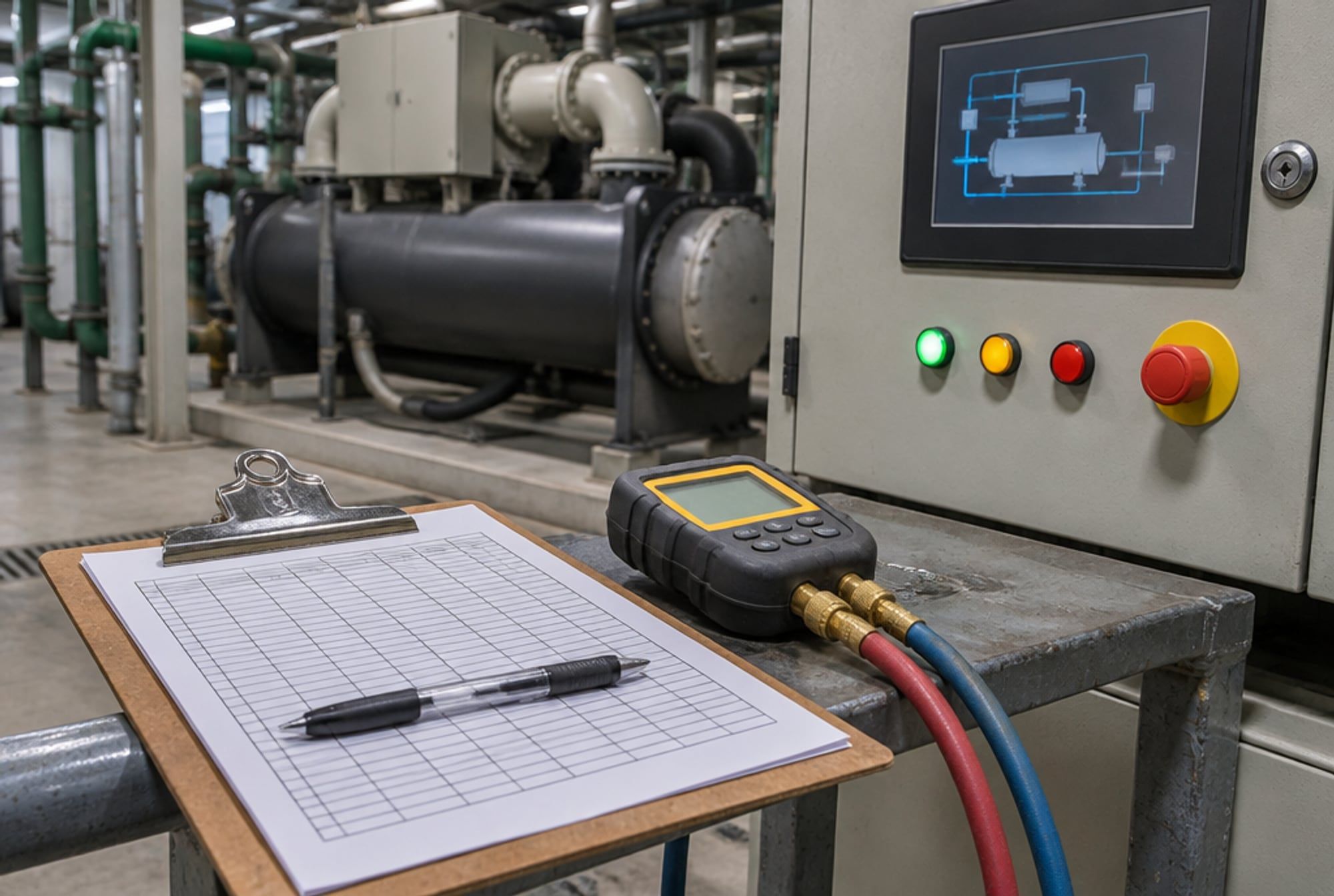
Early warning signs include rising amp draw, unusual noise, higher-than-normal discharge temperature, short cycling and a falling suction-to-discharge pressure difference. Logging these readings over time is more useful than a single snapshot.
Where are scroll compressors used?
- Residential and light commercial air conditioning and heat pumps
- Rooftop units and packaged systems
- Small and mid-size air-cooled and water-cooled chillers, typically as multiple compressors per circuit
- Commercial refrigeration, such as walk-in coolers and condensing units
- Process cooling and laboratory equipment
For larger chillers, see types of chillers for how scroll, screw and centrifugal machines compare.
How does a scroll differ from other compressors?
| Feature | Scroll | Reciprocating | Screw |
|---|---|---|---|
| Compression action | Orbiting spirals | Pistons in cylinders | Meshing helical rotors |
| Valves | None on suction | Suction and discharge valves | Typically none (slide valve for capacity) |
| Pulsation and noise | Low | Higher | Low to moderate |
| Typical size range | Small to mid | Small to mid | Mid to large |
| Field overhaul | Rare (hermetic) | Common in semi-hermetic | Common |
Frequently asked questions
Can a scroll compressor run backward?
On a three-phase compressor, yes, if two power leads are swapped. It will make an unusual noise, draw less current than expected and produce little or no pressure difference. It should be shut down immediately and the phase wiring corrected, because running backward for long can overheat and damage it.
How long does a scroll compressor last?
Life depends on duty cycle, operating conditions, refrigerant cleanliness and maintenance. Many last well over a decade in normal service, but short cycling, loss of oil return and electrical problems shorten that considerably. Treat any figure as a rough range, not a guarantee.
What oil does a scroll compressor use?
Compressors designed for HFC refrigerants generally use polyolester (POE) oil, which absorbs moisture readily and must be kept sealed until use. Always follow the compressor manufacturer’s oil specification. Oil analysis can reveal wear and contamination, as described in what oil analysis tells you.
SpecServis engineers in Ukraine work with compressors, chillers and refrigeration plants. We are planning to enter the Central Texas market and are looking for technicians, partners and a company to buy. See our open positions or partnership options.