By Priya Raman · Updated September 26, 2026 · 6 min read
Short answer
A rooftop unit is a packaged heating and cooling system that sits on a roof and supplies air through ducts. Most last roughly 15 to 20 years, with compressors, fans, economizers and heat exchangers the main wear parts. New units are moving to A2L refrigerants because of EPA and AIM Act limits, and the 2026 rule changes altered some dates, so owners should inventory equipment and check current EPA and Texas code requirements before planning replacements.
A rooftop unit (RTU) is a self-contained HVAC system installed on a roof, holding the compressor, condenser, evaporator coil, fans and, often, a gas furnace or heat pump in a single cabinet. It supplies conditioned air to the building through ductwork. RTUs cool most strip malls, schools, warehouses, restaurants and light commercial buildings in Texas, and they are now at the center of the refrigerant transition because most are cooling-only or heat pump equipment that used R-410A.
What are the main parts of an RTU?
| Component | Role |
|---|---|
| Compressor(s) | Circulate refrigerant; scroll compressors are most common, see refrigeration compressor types |
| Condenser coil and fans | Reject heat to outdoor air |
| Evaporator (DX) coil | Cools the air passing over it |
| Supply fan and motor | Move air through the building; belt or direct drive |
| Economizer | Uses cool outdoor air for free cooling when conditions allow |
| Heat section | Gas furnace, electric heat or heat pump |
| Controls and thermostat | Stage compressors, control dampers and fans |
| Filters and condensate drain | Protect the coil and handle moisture |
Unlike a chiller, an RTU cools air directly with refrigerant (DX). For how that differs, see how a chiller works.
How long do RTUs last?
Commonly cited service lives are about 15 to 20 years, but real life depends on climate, maintenance, and roof conditions. Hot, humid Texas climates with long cooling seasons, coastal salt air and dirty environments shorten life. A unit that runs many hours a year ages faster than one in a mild climate.
Where do RTUs usually fail?
- Compressors. Wear, electrical faults, low charge and short cycling shorten life; see compressor burnout.
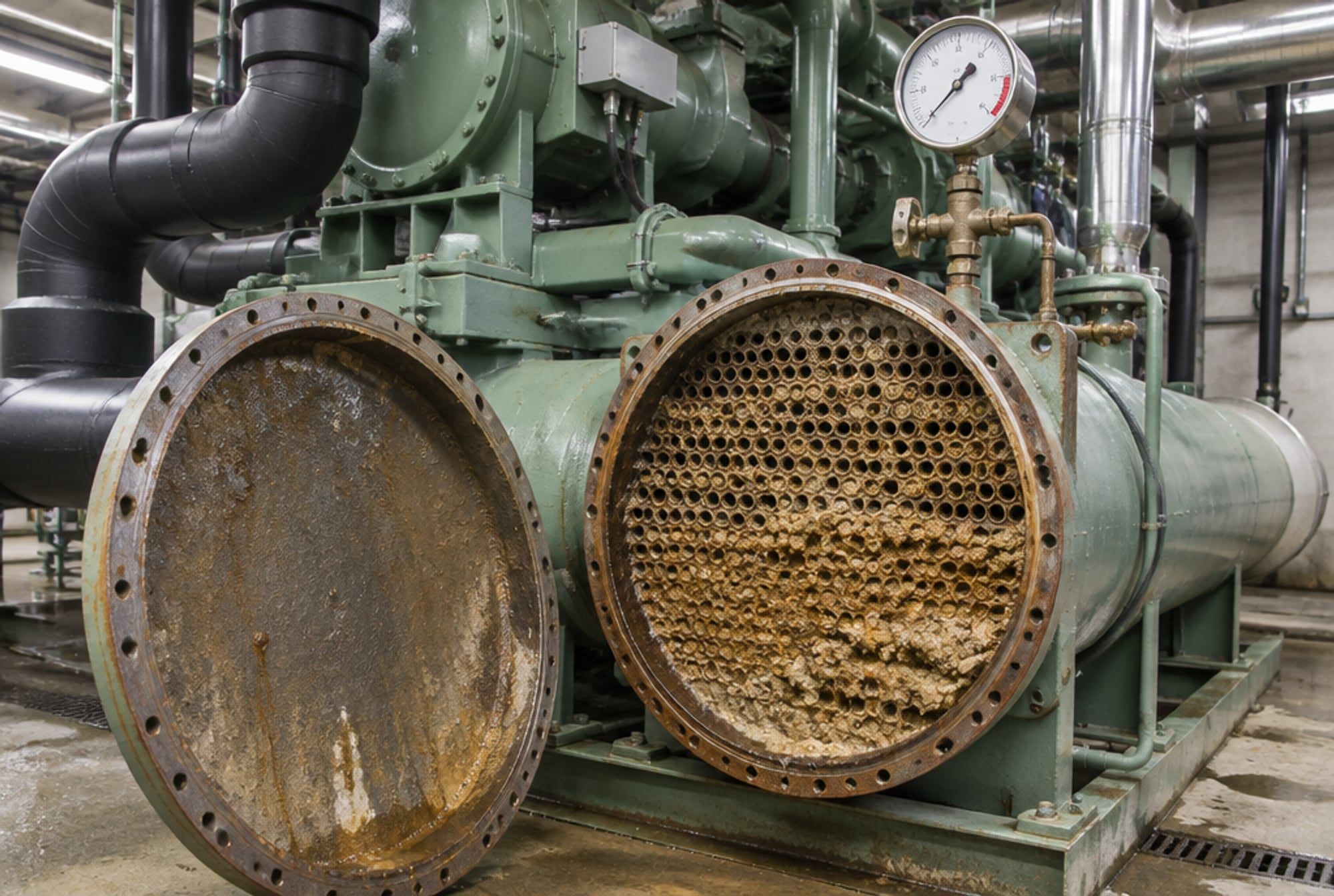
- Condenser coils. Dirt, cottonwood, hail damage and corrosion reduce capacity and raise head pressure.
- Fan motors and belts. Bearings, belts and pulleys wear and cause airflow loss.
- Economizers. Stuck dampers, failed actuators and bad sensors waste energy or admit hot air.
- Heat exchangers. Corrosion and cracking in gas furnace sections.
- Condensate drains. Clogs cause water damage.
- Controls. Failed contactors, boards and sensors.
Regular filter changes, coil cleaning and economizer checks catch most of these early.
What is the A2L transition, in plain terms?
The AIM Act directs EPA to phase down HFC production by 85% by 2036. EPA’s Technology Transitions rule sets GWP limits for new equipment in each sector; for most new comfort-cooling air conditioners and heat pumps the limit is 700. R-410A has a GWP above 2,000, so manufacturers are moving to lower-GWP refrigerants such as R-32 and R-454B. Both are A2L: low toxicity, mildly flammable. See A2L refrigerants explained for the safety class and handling basics.
For RTUs this means:
- New units are redesigned for A2L: different compressors, coils, controls and, often, refrigerant leak sensors and mitigation.
- Replacement parts and service procedures change, and technicians need A2L-rated tools and training.
- Existing R-410A units are not banned from use. Reports on the rules state that servicing existing equipment continues.
What changed in 2026, and what is the 2027 date?
EPA finalized changes to the 2023 Technology Transitions rule in May 2026. Per industry coverage, the changes remove the January 1, 2026 installation deadline for some residential and light commercial AC and heat pump systems that use refrigerants above the 700 GWP limit, provided the equipment was made or imported before the cutoff date. A separate 2027 date applies to variable refrigerant flow (VRF) systems, with January 1, 2027 cited for installation of certain pre-2026 equipment. Those details are for specific system types, and the rule’s compliance dates, definitions and effective dates are technical. Confirm the dates for your equipment in the Federal Register notice and on EPA’s Technology Transitions page before acting.
Texas also changed building codes. TDLR adopted the 2024 International and Uniform Mechanical Codes with an effective date of September 1, 2026, in part because the earlier codes do not cover A2L installation and service. Local jurisdictions such as Austin and Dallas can enforce different editions, so check with the local building department.
How should facility teams plan RTU replacements for 2027?
- Inventory every RTU: make, model, serial, tonnage, refrigerant and install year. The nameplate has most of this; see how to read a compressor nameplate.
- Rank by age and condition, and flag units over about 15 years with repeated repairs.
- Budget replacements in waves, not as emergencies. Replacing a failed unit in July with a lead time of weeks is costly and stressful.
- Check lead times and specs for A2L models: curb adapters, weight, electrical, and leak mitigation controls may differ from the old unit.
- Review codes and permits with the local building department for A2L installations.
- Ask service providers about A2L training and certification before the replacement season.
- Consider efficiency upgrades such as economizers, variable-speed fans and better controls while the unit is open.
Frequently asked questions
Can I still repair an R-410A RTU?
Reports on the current rules say there is no end date for servicing existing R-410A systems. Supply and price of the refrigerant may change, so check the EPA pages.
Can an old RTU be converted to A2L refrigerant?
Not by simply swapping refrigerant. A2L systems are designed for those refrigerants and their safety features. Do not retrofit without manufacturer approval.
Is an RTU the same as a split system?
No. An RTU packages everything in one outdoor cabinet; a split system has indoor and outdoor sections connected by refrigerant lines.
SpecServis follows the HVAC and refrigeration rules because we are planning to enter Central Texas. We are looking for technicians and partners. See our open positions or partnership options.