By Marcus Lindqvist · Updated August 4, 2026 · 6 min read
Short answer
An air-cooled condenser rejects heat from refrigerant to outdoor air using a finned coil and fans. It desuperheats, condenses and subcools the refrigerant. Capacity depends on the temperature difference between condensing refrigerant and ambient air, so hot weather raises head pressure and cuts efficiency. Clean coils, working fans and correct sizing for design ambient keep it performing.
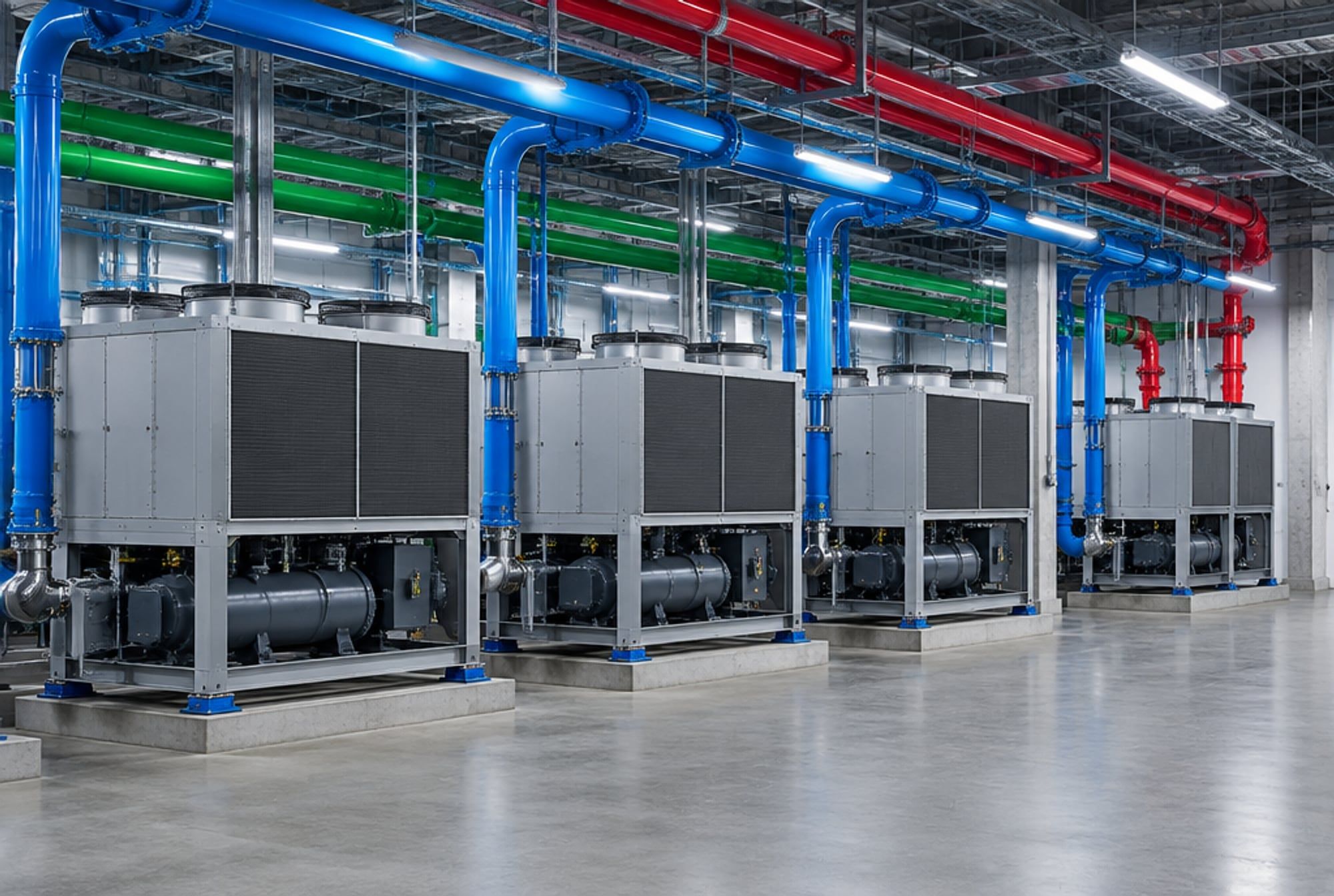
An air-cooled condenser is a heat exchanger that moves heat from hot refrigerant gas to outdoor air. Fans pull or push air across a finned coil, and the refrigerant inside the tubes cools, condenses to liquid and leaves slightly subcooled. It does the same job as the condenser in a water-cooled system, without cooling towers or water treatment. The tradeoff is that its performance follows the outdoor air temperature, which matters a great deal in a hot climate.
What are the main parts of an air-cooled condenser?
- Coil. Copper or aluminum tubes with aluminum fins, sometimes with coatings for corrosion resistance. Microchannel aluminum coils are common on newer equipment.
- Fans and motors. Axial fans, either fixed speed, staged or driven by variable speed or EC motors.
- Headers and circuiting. Distribute refrigerant across the coil and collect liquid.
- Controls. Fan cycling or speed control to hold a target condensing pressure.
- Casing and frame. Support, air flow guidance and sound control.
- Optional extras. Receiver, hail guards, spray or adiabatic pre-cooling.
The condenser can be a standalone unit connected by refrigerant piping to a compressor rack, or it can be built into a packaged air-cooled chiller. For the chiller side, see air-cooled vs water-cooled chillers.
How does an air-cooled condenser work?
Refrigerant arrives from the compressor as hot, high-pressure vapor. It passes through three phases inside the coil:
- Desuperheating. The vapor cools down to its saturation temperature.
- Condensing. Most of the heat is released here as the vapor turns into liquid at nearly constant temperature.
- Subcooling. The liquid cools a few degrees below saturation, which protects the expansion device and adds capacity.
The heat released equals the evaporator load plus the compressor’s work. That is why a condenser must be sized for more than the cooling duty alone. The basic cycle is described in how a chiller works.
How is an air-cooled condenser sized?
Condenser capacity depends on three things: the heat to reject, the air flow, and the temperature difference (TD) between condensing refrigerant and the entering air. Selection usually follows these steps:
- Determine total heat rejection from the compressor data at design conditions.
- Choose a design ambient temperature. This should reflect local extreme weather, not an average day.
- Select a design TD. Smaller TD means a larger, more expensive coil and lower head pressure.
- Check fan power, sound level and footprint.
- Verify the minimum condensing pressure at cold weather for the expansion device and oil return.
Manufacturers publish ratings in a standard format, so compare equipment at the same conditions. In general, a larger condenser costs more at purchase but lowers compressor power for the life of the system.
What changes in high ambient climates like Central Texas?
Summer afternoons in Texas can push outdoor air to extreme temperatures, and rooftop or ground-level heat can run higher still. The effects:
| Condition | Effect on the system |
|---|---|
| Higher entering air temperature | Higher condensing pressure and more compressor power |
| Reduced capacity at peak heat | The compressor may unload or trip on high pressure |
| Hot air recirculation | Discharge air returns to the intake and raises effective ambient |
| Solar load on coils and casing | Adds to the effective air temperature |
| Longer operating hours at high head | More wear on compressors and fans |
Common mitigation measures include selecting for a realistic peak design temperature, leaving clear space around the unit, keeping coils clean, using variable-speed fans, and considering adiabatic pre-cooling where water is available. The efficiency side of this is covered in chiller efficiency: kW per ton, COP and IPLV. Refrigerant choice also affects condensing behavior, as explained in refrigerants: what is changing in 2026.
What maintenance keeps a condenser efficient?
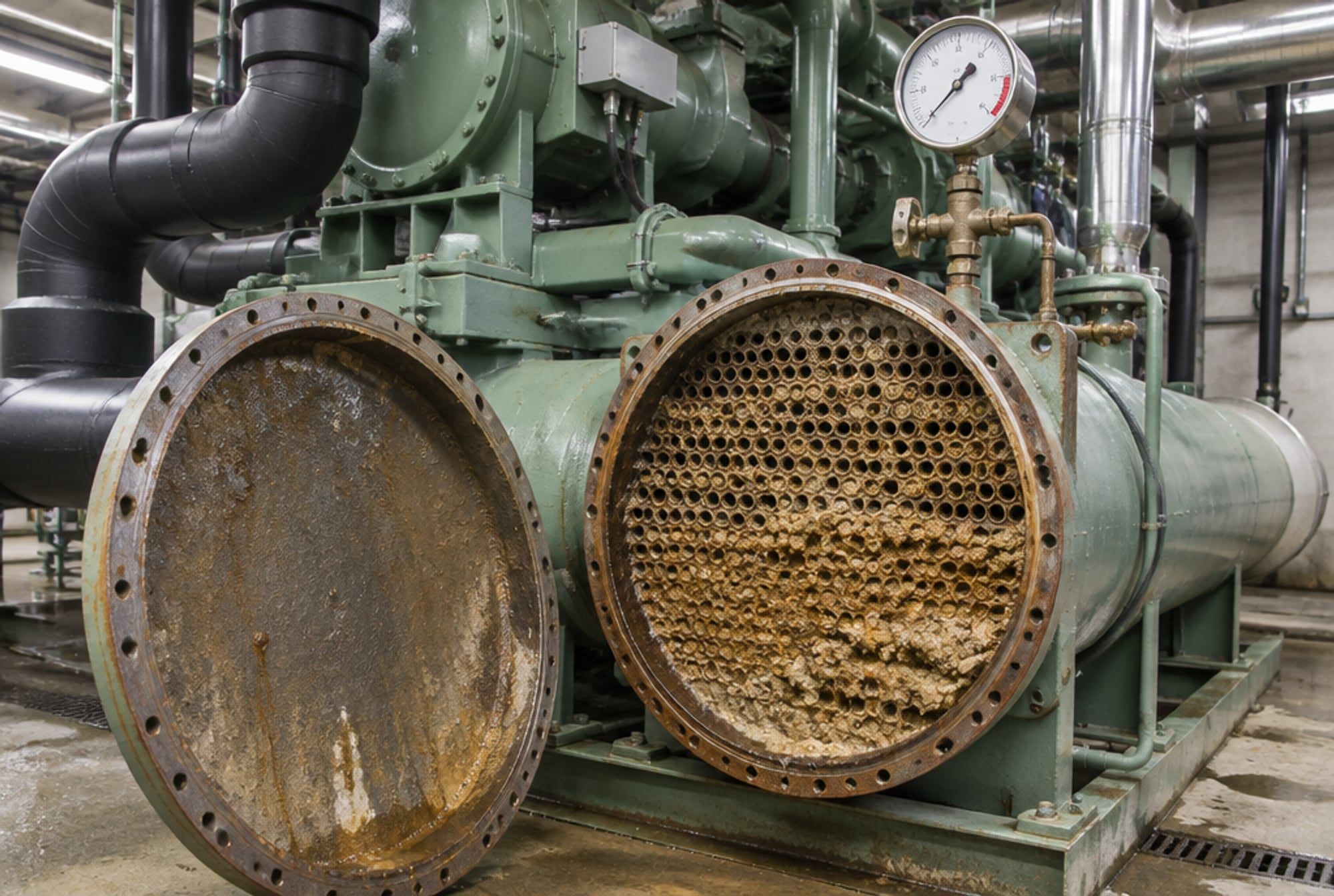
- Coil cleaning. Dirt, cottonwood, grass clippings and grease insulate the fins and cut air flow. Clean from the inside out where possible, and avoid bending fins.
- Fin straightening. Damaged fins block air flow.
- Fan inspection. Check blades, bearings, motor current and rotation direction.
- Refrigerant leak checks. Coil leaks are common on corroded or vibrating tubes.
- Control checks. Confirm fan staging and pressure setpoints.
- Clearances. Remove obstructions, vegetation and nearby heat sources.
A related routine for the whole plant is in chiller maintenance checklist.
Frequently asked questions
Why is my head pressure high on hot days?
Head pressure rises with entering air temperature, so some increase is normal. Excessive pressure usually points to a dirty coil, failed fans, recirculating air, non-condensables in the system or an overcharge.
Is an air-cooled condenser better than a water-cooled one?
It depends. Air-cooled designs avoid water use, tower maintenance and treatment, and are simpler. Water-cooled systems usually reach lower condensing temperatures and better efficiency, particularly in hot weather, at the cost of more equipment and water management.
How much clearance does a condenser need?
Follow the manufacturer’s drawings. Air must reach the coil freely and the discharge must not return to the intake. Walls, other units and screens that limit air flow will lower capacity.
SpecServis engineers in Ukraine work with industrial chillers and refrigeration plants. We are planning to enter the Central Texas market and are looking for technicians, partners and a company to buy. See our open positions or partnership options.