By Priya Raman · Updated September 15, 2026 · 6 min read
Short answer
Liquid cooling removes heat with fluid at the chip or rack instead of moving large volumes of air. The main types are direct-to-chip cold plates, rear-door heat exchangers and immersion. AI racks that exceed what air can handle drive adoption, and the liquid loop still needs a plant that rejects heat, usually chillers or dry coolers.
Liquid cooling uses water, a water-glycol mix or a dielectric fluid to carry heat away from servers. Liquid holds far more heat per volume than air, so it can cool racks that air cannot. AI training servers push rack power to 40 kW and well beyond 100 kW in current designs, compared with roughly 5 to 15 kW in a conventional room, and that gap is the reason liquid cooling has moved from niche to mainstream.
What are the main types of liquid cooling?
Direct-to-chip (cold plate). Metal plates sit on the processors and accelerators. Coolant flows through them to a coolant distribution unit (CDU), which exchanges heat with the facility water. Air still cools the remaining components, such as memory and power supplies, so most designs are hybrid.
Rear-door heat exchangers. A water-cooled coil mounted on the back of the rack cools the exhaust air before it enters the room. It adds capacity to existing air-cooled halls without touching the servers.
Immersion. Servers sit in a bath of dielectric fluid. Single-phase systems circulate the fluid through a heat exchanger. Two-phase systems let the fluid boil and condense. Immersion removes nearly all fans but needs different hardware, handling and service procedures.
How does liquid cooling connect to chillers?
The server-side loop is only part of the system. Heat still has to leave the building:
- Coolant picks up heat at the chip or rack.
- A CDU transfers it to a facility water loop.
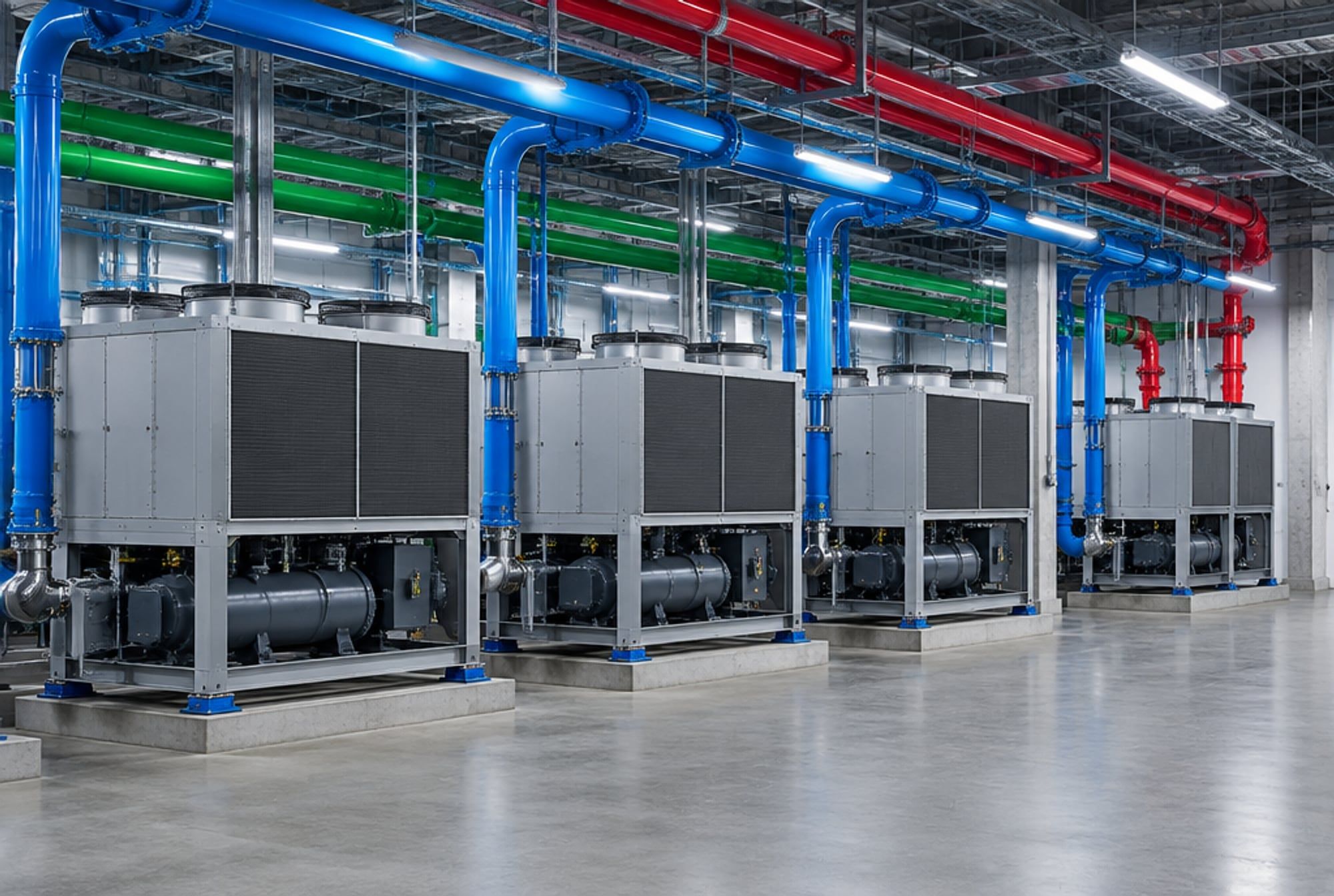
- The facility loop rejects heat through chillers, dry coolers or cooling towers.
Liquid cooling often works with warmer water than air cooling. Many designs supply facility water in roughly the 86°F to 113°F range, a spread that depends on the hardware vendor. In cooler climates that allows dry coolers and little or no compressor use. In Texas heat, chillers or trim cooling is usually still needed in summer.
Air vs liquid: what changes?
| Factor | Air cooling | Direct-to-chip liquid |
|---|---|---|
| Practical rack density | up to about 15–20 kW | 40 kW to over 100 kW |
| Heat carried by | large volumes of air | small volumes of fluid |
| Fan energy | high | lower, but not zero |
| Leak risk | none from coolant | needs leak detection and quality fittings |
| Retrofit | existing standard | needs piping, CDUs and rack changes |
What are the risks and trade-offs?
- Leaks and fittings. Quick-disconnects, manifolds and hoses need quality control, pressure testing and leak detection.
- Fluid quality. Coolant chemistry, filtration and corrosion control protect cold plates, which have very fine channels.
- Mixed loads. Racks that are partly liquid-cooled still need air for the remainder, so the room cannot ignore its air system.
- Standards and warranties. Server and CDU vendors specify acceptable fluids, temperatures and flow; follow them.
- Skills. Technicians need refrigeration, hydronic and controls knowledge in one team.
Why does this matter in Austin?
Central Texas has attracted data center projects and research on advanced cooling. For example, the University of Texas at Austin has worked with Austin-based Accelsius on two-phase direct-to-chip cooling, with the goal of cutting cooling energy from as much as 40% of a data center’s load to under 5%. Closed-loop liquid systems paired with air-cooled chillers are also described as a water-efficient option for large Texas data centers, though dry cooling alone is hard in a hot climate. Design requirements and rules are changing quickly, so check current sources. For the wider picture see data center cooling explained.
What should you plan for before adopting liquid cooling?
Liquid cooling changes the building as well as the rack, so check these items early.
- Heat rejection capacity. Even when most heat goes into liquid, it still has to be rejected. Higher supply temperatures can allow more free cooling, which is covered in data center chillers and cooling towers in Texas.
- Water use. The choice between evaporative and dry rejection has a large impact; see Texas data centers and water use.
- Electrical impact. Cooling power is part of the total request, so ERCOT large-load considerations matter for projects at scale.
- Water quality. Cold plates have narrow channels. Filtration and fluid chemistry need a defined program, similar to chilled water system water treatment.
- Hybrid operation. Many halls will keep air cooling for some equipment, so the plant must serve both.
- Leak detection and response. Define sensors, isolation valves and procedures before commissioning.
A written commissioning plan, with flow, temperature and pressure checked at each stage, is far cheaper than finding a loop imbalance after the servers are installed.
Frequently asked questions
Is liquid cooling more efficient than air cooling?
Usually at high density, yes. It cuts fan energy and allows warmer facility water, which lets chillers run less or not at all. The saving depends on climate and design.
What is a CDU?
A coolant distribution unit separates the server coolant loop from the facility water loop, controls temperature and flow, and filters the fluid.
Does liquid cooling need chillers?
Not always. It needs a heat rejection plant. In hot climates that often includes chillers, at least in summer.
We would like to meet engineers and contractors who work on cooling plants in Central Texas. See our open positions or partnership options.