By Marcus Lindqvist · Updated October 27, 2026 · 7 min read
Short answer
A refrigeration rack groups several compressors on one frame to serve many cases and coolers through shared piping, while a condensing unit pairs a compressor and condenser to serve one or a few loads. Racks tend to be more efficient and easier to control at scale but hold more refrigerant and a bigger failure risk. Condensing units are simpler and isolate failures but multiply equipment. Refrigerant rules and site size should guide the choice.
A refrigeration rack is a group of compressors mounted on a common frame, sharing suction and discharge headers, that serves many display cases and walk-in coolers through long refrigerant piping. A condensing unit is a self-contained compressor and condenser serving one cooler, freezer or small group of loads. Racks usually win on efficiency and control for sites with many loads, such as supermarkets. Condensing units usually win on simplicity, isolation of failures and low upfront cost for sites with a few loads, such as restaurants and convenience stores.
What is the basic difference?
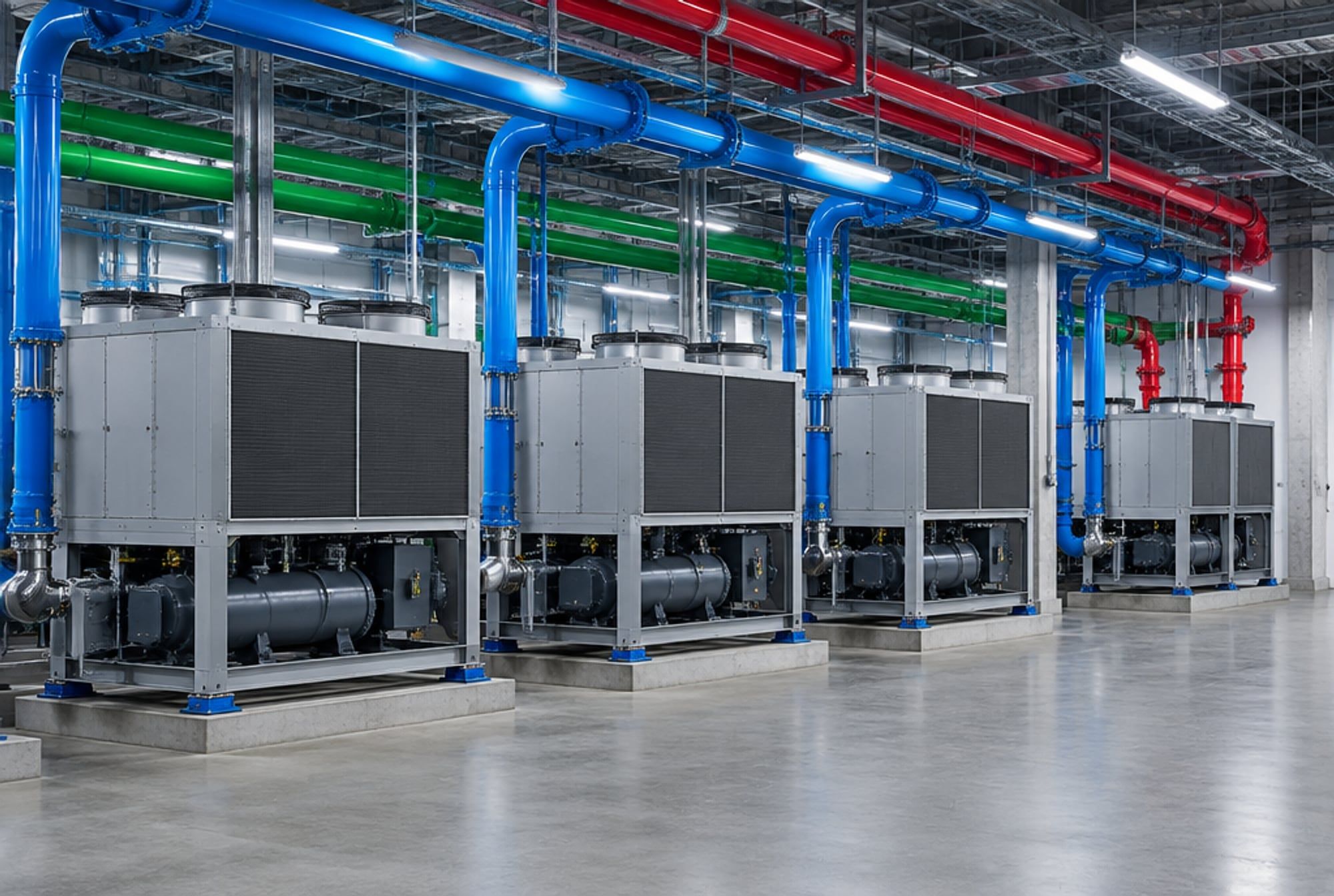
In a central rack system, compressors of different sizes are staged to match the combined load. Suction lines gather vapor from many evaporators, and one or more condensers, usually on the roof, reject heat. The machine room holds the compressors, controls, oil management and receivers.
In a condensing unit setup, each cooler or freezer has its own outdoor or remote compressor and condenser. There is no shared header, so each system is independent. Typical examples are a walk-in cooler with a dedicated unit on the roof or wall; for the box itself see walk-in freezer vs walk-in cooler.
How do racks and condensing units compare?
| Factor | Central rack | Condensing units |
|---|---|---|
| Best fit | Many loads, large footprint, supermarkets, food distribution | One to a few loads, restaurants, convenience stores, small retail |
| Refrigerant charge | Large, spread over long piping | Smaller per system, but many systems |
| Efficiency potential | High with floating head pressure, heat recovery and good controls | Good with modern variable-speed or scroll units; fewer optimization options |
| Failure impact | A major fault can affect many cases at once, though multiple compressors give redundancy | One unit fails, one box is affected |
| Piping and install | Complex, long runs, more brazed joints | Simple, short runs |
| Maintenance | Specialized skills, central location | Spread across many units, often on roofs or walls |
| Expansion | Add compressors or circuits within limits | Add another unit |
| Leak exposure | More piping and fittings; leak history is a big industry issue | Fewer joints per system |
The table describes typical patterns. Specific equipment and design quality can change the result.
When does a rack make sense?
Racks make sense when the load is large, varied and concentrated in one building. The compressors are staged, so part-load operation is efficient, and a controller can float head pressure, adjust defrost, and capture heat for space or water heating. Multiple compressors on one rack provide redundancy: if one trips, the others continue, often with reduced capacity.
Racks also help when the owner wants one place to monitor and maintain. Machine rooms centralize noise and service access, which keeps work off the sales floor and off the roof.
The downsides are the refrigerant charge and the piping. Long runs and many joints increase leak potential, and supermarket leak rates have been a regulatory focus. See EPA 608 leak repair rules.
When do condensing units make sense?
Condensing units fit sites with a small number of loads. Because each system is independent, a failure only affects one cooler, and a new unit can be added without disturbing the others. Installation is simpler, piping is short, and refrigerant charge per system is small, which reduces leak risk and lowers the cost of a leak.
They also suit phased construction, leased spaces and chain stores that standardize on a small set of equipment. Scroll compressors, often with variable speed, are common here; see scroll compressors and variable-speed (VFD) compressors.
The tradeoffs: more equipment to maintain, less optimization between systems, and a cluttered roof or utility area. A site with ten units has ten sets of compressors, fans and controls that need attention.
How do refrigerant rules change the picture?
Refrigerant regulations are pushing both designs toward lower-GWP refrigerants. EPA’s Technology Transitions rule sets limits for new equipment by sector, including remote condensing units and centralized systems, and some compliance dates cluster around the start of 2027. Because the categories and dates are technical, confirm current requirements on EPA’s site; see HFC deadlines, January 2027 and R-404A replacement: R-448A and R-449A.
How this affects each design:
- Racks are moving toward CO2 (R-744) systems, low-GWP HFC blends, or cascade and secondary-loop designs that cut the amount of high-GWP refrigerant. See CO2 transcritical refrigeration.
- Condensing units are moving toward low-GWP blends and, for small systems, propane (R-290) self-contained designs. See R-290 propane refrigeration.
- Existing equipment is not automatically banned, but leak rules and refrigerant supply remain concerns.
What should a facility team ask before choosing?
- How many loads and how large are they? A single walk-in does not need a rack; forty cases probably do.
- What is the cost of an outage? Food loss risk may favor redundancy, either multiple compressors or separate systems.
- Who will service it, and how fast? A complex rack needs skilled technicians nearby.
- What is the refrigerant plan? Ask what refrigerant the manufacturer offers today and what its availability and regulatory outlook looks like.
- Can heat be reused? Racks make heat recovery easier.
- What do local codes and utilities say? Machine rooms, ventilation and leak detection requirements vary.
- What does the whole-life cost look like? Compare energy, maintenance, refrigerant and replacement, not just first cost.
Frequently asked questions
Is a rack always more efficient than condensing units?
No. Racks have more optimization options, but poor design or maintenance can erase the advantage. Modern condensing units with variable-speed compressors can be competitive at small scale.
Which has more leak risk?
Racks generally have more piping and joints, so more potential leak points. Condensing units hold less refrigerant per system, but there are more of them. Leak detection and good installation matter either way.
Can I mix a rack and condensing units in one building?
Yes, and it is common. A rack may serve display cases while separate condensing units serve walk-ins or special rooms.
SpecServis engineers in Ukraine have worked with refrigeration systems and compressors, and we are planning to enter Central Texas. We are looking for technicians and partners. See our open positions or partnership options.