By Marcus Lindqvist · Updated October 26, 2026 · 7 min read
Short answer
VRF, chilled water and rooftop units are the three most common ways to cool a commercial building. RTUs are simple and cheap for single-story buildings, VRF suits mid-size buildings that need zone-by-zone control and heat recovery, and chilled water suits large or complex buildings with long lives and high loads. Each carries different refrigerant exposure, so the choice should follow building size, zoning, maintenance capability and current EPA and Texas code requirements.
There is no single best system. A rooftop unit (RTU) is usually the lowest-cost choice for a one- or two-story building with simple zoning, a variable refrigerant flow (VRF) system fits mid-size buildings that need individual zone control, and a chilled water plant fits large buildings, campuses and process loads where efficiency and service life matter most. The right answer depends on building size, how many zones you need, who will maintain the equipment, and how much refrigerant you are willing to put inside occupied space.
How do the three systems differ at a glance?
| Factor | RTU (packaged DX) | VRF | Chilled water |
|---|---|---|---|
| How it cools | Refrigerant cools supply air directly in one rooftop cabinet | Outdoor units pipe refrigerant to many indoor units | A chiller cools water; pumps send it to coils in air handlers |
| Typical building | Retail, schools, warehouses, light commercial | Offices, hotels, clinics, mixed-use mid-rise | Large offices, hospitals, campuses, data centers, industrial |
| Zoning | Limited; one unit serves one zone or a duct system | Excellent; each room or zone has its own indoor unit | Good; depends on air handlers, VAV boxes and valves |
| Refrigerant location | Contained on the roof | Piped through the building to occupied spaces | Mostly inside the chiller plant |
| First cost | Lowest per unit | Higher than RTUs, often lower than a full plant | Highest for small buildings; scales well for large ones |
| Typical service life | Roughly 15 to 20 years | Often similar to or a bit longer than RTUs | Chillers commonly last longer; see chiller lifespan |
| Maintenance skills | Common HVAC skills | Specialized VRF training and controls knowledge | Chiller, controls and water treatment skills |
These are general patterns. Individual products and building conditions vary, so treat the table as a starting point for questions, not a selection rule.
When does an RTU make sense?
An RTU packages the compressor, condenser, evaporator coil, fans and often heat in one cabinet. For a single-story building with a handful of zones, it is hard to beat on simplicity. Each unit is independent, so one failure does not shut down the building, and replacement is a crane lift rather than a redesign. For the basics, see RTU basics and the A2L transition.
The tradeoffs are efficiency at part load, limited zoning, and the fact that units live on a roof exposed to Texas sun, hail and dust. Fixed-speed compressors cycle on and off, which is less efficient than modulating equipment. Larger buildings end up with many RTUs, each with its own compressors, filters and economizer to maintain.
When does VRF make sense?
VRF systems use variable-speed compressors and electronic expansion valves to send exactly the refrigerant each indoor unit needs. That allows many small zones, quiet indoor units, and in heat recovery versions, moving heat from one zone that is cooling to another that is heating. They also avoid large ducts, which helps in renovations with low ceilings.
Practical considerations:
- Refrigerant volume in occupied space. Long piping runs mean more refrigerant spread through the building. Codes and standards limit how much refrigerant can be in a space, and leak detection may be required. See A2L refrigerants explained.
- Specialized service. Controls, communication wiring and commissioning matter more than in a simple RTU. Poor commissioning is a common source of disappointing performance.
- Brazing quality. Many field joints mean more potential leak points, so pressure testing and clean installation are critical.
- Repair complexity. A single outdoor unit often serves many zones, so a failure can affect a large part of the building.
When does chilled water make sense?
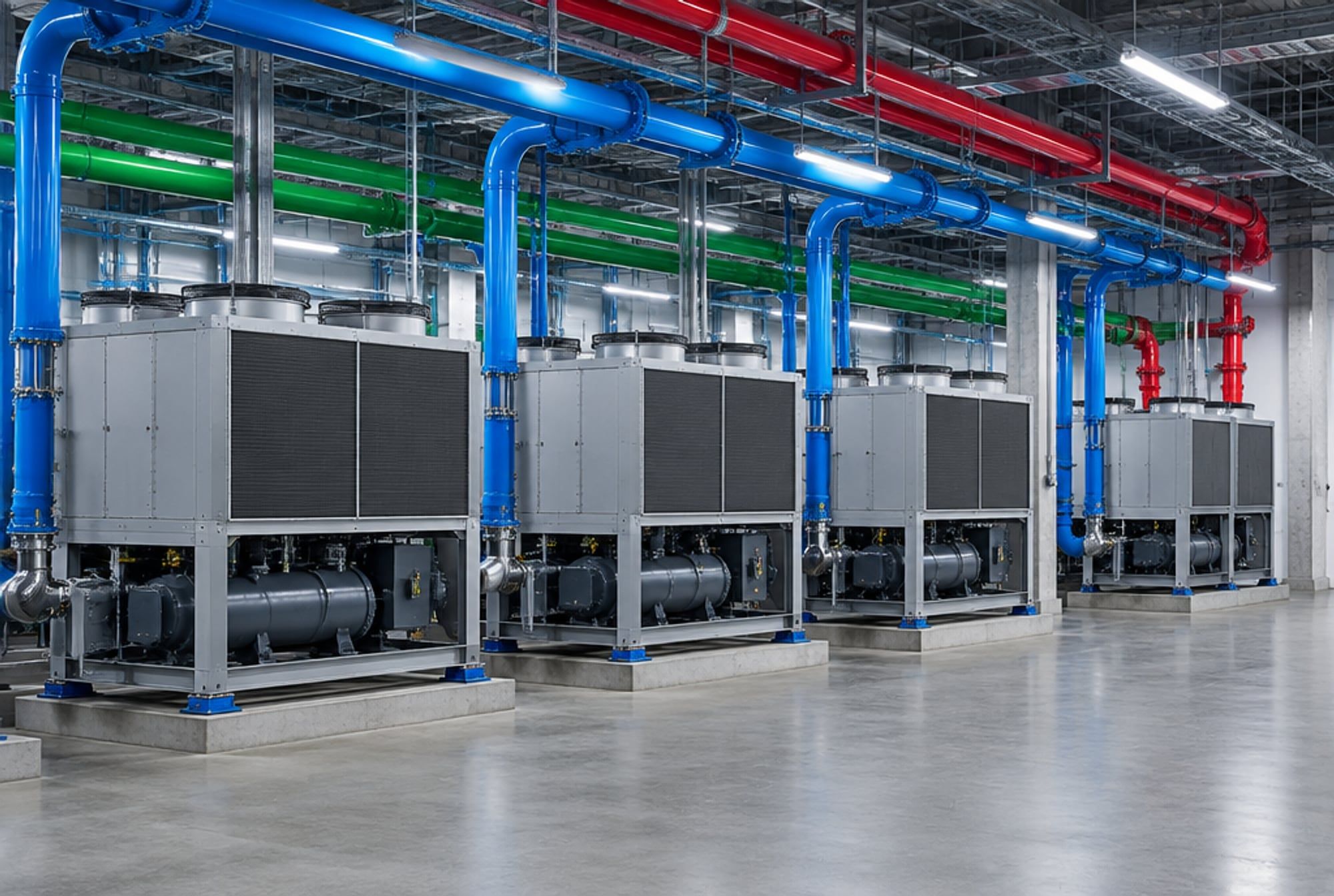
A chilled water system moves cooling as water, which is a safe, efficient carrier over long distances. One or more chillers sit in a plant room, with pumps, piping, cooling towers or air-cooled condensers, and air handling units in the building. Because refrigerant stays in the plant, the amount in occupied areas is minimal. Large centrifugal or screw chillers reach high efficiency; see chiller efficiency, kW per ton and IPLV and types of chillers.
Chilled water becomes attractive when:
- The building is large enough that central equipment beats many small units.
- Loads are steady and high, such as hospitals, labs, data centers and industrial processes.
- Thermal storage or heat recovery is planned; see thermal energy storage explained.
- A long service life is expected and the owner can support a plant room and water treatment; see chilled water system water treatment basics.
The costs are real. Piping, pumps, controls, plant space and water treatment add first cost and maintenance obligations. For a small building, they often outweigh the efficiency gains.
How do refrigerant rules affect the choice?
All three families are affected by the HFC phasedown and the move toward lower-GWP refrigerants. EPA’s Technology Transitions rule sets limits for new equipment by sector, and the 2026 changes altered some dates and categories, including treatment of VRF systems. The details are technical and sector specific, so confirm the current requirements for the exact equipment type on EPA’s site; see technology transitions rule 2026 update and refrigerants: what is changing in 2026.
In general terms:
- RTUs and VRF typically move to A2L refrigerants such as R-32 or R-454B. These are mildly flammable, which brings code, installation and leak-mitigation requirements.
- Chilled water chillers use a range of refrigerants, including low-GWP HFOs and, for some designs, natural refrigerants, with the refrigerant confined to a machinery room.
- Texas code adoption matters. The 2024 mechanical codes and local amendments determine how A2L equipment is installed; see Texas 2024 mechanical codes: what changed.
How should an owner choose?
- Define the load and the zones. How many independent temperature zones does the building need, and how variable is the occupancy?
- Estimate the life of the building and the equipment. A 40-year campus favors central plants; a five-year lease favors simple RTUs.
- Ask who will maintain it. A system your local contractors cannot service well will cost more over time.
- Look at electrical and demand impact. Variable-speed systems reduce peaks; see demand charges and chiller scheduling.
- Compare life-cycle cost, not just first cost. Include energy, maintenance, refrigerant changes and replacement.
- Review code and refrigerant requirements early, with the engineer of record and the local building department.
Frequently asked questions
Is VRF more efficient than an RTU?
Often at part load, yes, because variable-speed compressors and zoning avoid overcooling. Real results depend on design, commissioning and controls, so compare modeled energy use rather than assuming.
Can a chilled water system serve a small building?
It can, but the plant, pumps and water treatment usually make it hard to justify below a certain size. Air-cooled packaged chillers narrow that gap.
Do I have to replace an existing system because of the refrigerant changes?
Rules for existing equipment generally differ from rules for new equipment. Check the current EPA guidance and talk to your engineer before making replacement decisions.
SpecServis engineers in Ukraine have worked with chillers and refrigeration systems, and we are planning to enter Central Texas. We are looking for technicians and partners. See our open positions or partnership options.